

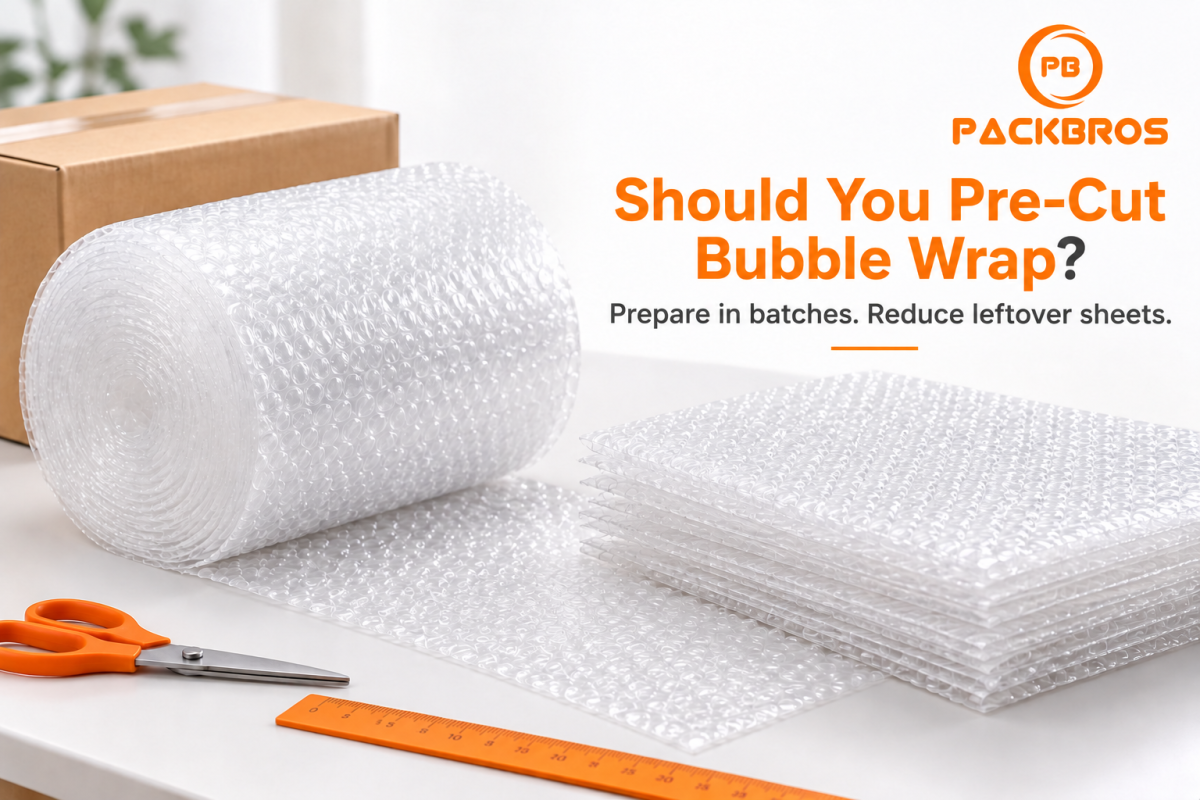
Should You Pre-Cut Bubble Wrap Before Packing Orders?
Pre-cutting bubble wrap can be useful when product dimensions and order quantities are predictable. It allows packers to pick up a prepared sheet and continue wrapping without measuring and cutting for every item.
However, preparing too many sheets can leave you with unused sizes and a crowded workspace. Start with the next confirmed packing batch and adjust preparation quantities using actual consumption.
When Does Pre-Cutting Make Sense?
Preparing bubble wrap sheets in advance is worth considering when:
- The same products are packed repeatedly.
- The required sheet dimensions have already been tested.
- The next batch quantity is confirmed.
- Different sheet sizes can be stored separately.
For example, a batch of 80 identical products may be suitable for advance preparation if the packing method is already established.
Before cutting, confirm the appropriate sheet dimensions. This guide to setting a bubble wrap standard for each SKU explains how to keep material usage consistent across employees.
Does Pre-Cutting Actually Save Time?
It may improve the flow of wrapping, but the cutting work still has to be done.
Separating preparation from wrapping can reduce repeated switching between tools. The full comparison must also include the time spent cutting, sorting, storing and retrieving sheets.
Test both methods using comparable products and quantities.
| What to Measure | Cutting During Packing | Preparing Sheets in Batches |
|---|---|---|
| Material preparation | Included in each packing cycle | Timed before wrapping |
| Wrapping and sealing | Time the complete batch | Time the complete batch |
| Unused or incorrectly sized sheets | Record the quantity | Record the quantity |
| Packages requiring rework | Record the quantity | Record the quantity |
Choose the method that improves total completion time while maintaining the required packing quality.
How Many Sheets Should You Prepare?
Use the next confirmed batch as your starting point, then subtract any suitable sheets already available.
Illustrative example
The next batch contains 80 items. You already have 15 correctly sized sheets, so you need to cut another 65.
If each sheet uses 60 cm of roll length and the full roll width:
65 × 0.60 m = 39 m of bubble wrap
This theoretical quantity excludes cutting waste and rework. If several sheets are cut across the roll width, calculate the cutting layout separately.
Base any additional allowance on observed waste rather than automatically preparing a large surplus.
How Should Prepared Sheets Be Stored?
Separate sheets by dimensions and label each storage position clearly.
For example:
50 cm wide × 60 cm long — SKU A
Labels such as “small” and “large” can cause confusion when several sizes are in use.
Keep prepared sheets clean, dry and protected from heavy loads. Separate damaged or incorrectly sized pieces from ready-to-use material.
If prepared sheets take over the work surface, review your packing station layout so preparation stock does not obstruct wrapping and sealing.
When Is Cutting From the Roll More Practical?
Cutting as needed remains useful for irregular products, custom orders and shipments requiring different wrapping dimensions.
Many businesses can combine both approaches:
- Prepared sheets for repeat products.
- Bubble wrap rolls for variable or unusual items.
When reviewing PackBros bubble wrap and packaging products, provide the product dimensions, tested sheet size and typical batch quantity. These details help identify an appropriate roll width.
Frequently Asked Questions
Does cutting bubble wrap into sheets reduce its protection?
Cutting alone does not automatically reduce protection. Check bubble condition, tears and whether the sheet provides the coverage required by the packing method.
Should I prepare enough sheets for the entire day?
That can work when the schedule is stable and storage is available. Smaller preparation batches are easier to adjust when orders change frequently.
Can leftover sheets be used for another product?
Yes, if the dimensions and condition are suitable. Test the alternative product rather than forcing a sheet that is too narrow or short.
Conclusion
Start with a repeat product and a confirmed batch. Measure the complete process and record leftover sheets after packing. This gives you a practical basis for deciding how much bubble wrap to prepare in advance.