
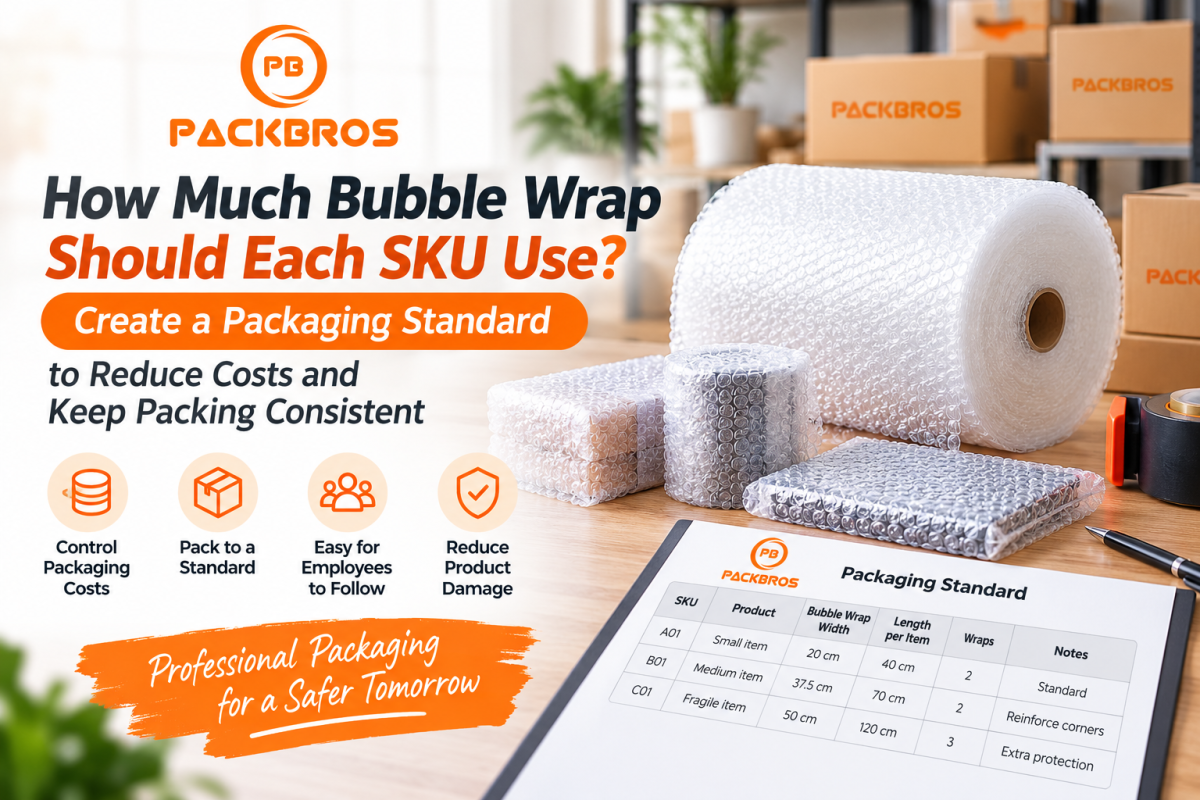
How Much Bubble Wrap Should Each SKU Use? Create a Packaging Standard to Reduce Costs and Keep Packing Consistent
As an online store grows and more employees become involved in packing orders, one problem often appears without the business owner noticing:
The same product is being packed with different amounts of bubble wrap by different employees.
One employee may use 60 cm of bubble wrap for a particular product. Another may use 80 cm, while someone else may use 1 meter simply because they want to make sure the product is well protected.
All three packages may protect the product successfully, but their packaging costs are different.
When this happens across hundreds or thousands of orders every month, the extra bubble wrap can become a significant and unnecessary expense.
One way to control this problem is to create a Packaging Standard for each SKU.
What Is a Packaging Standard?
A Packaging Standard defines exactly how each product should be packed.
Instead of simply telling employees:
“Wrap it securely with bubble wrap.”
A business can specify:
- Bubble wrap width
- Length of bubble wrap per item
- Number of wrapping layers
- Areas that require additional protection
- Mailer or packaging size
- Tape requirements
- Special packing instructions
When everyone follows the same standard, both packaging quality and material consumption become more consistent.
1. Start With Your Best-Selling SKUs
You do not need to create a Packaging Standard for every product at once.
Start with your top-selling SKUs.
These products have the greatest impact on packaging costs because they are packed most frequently.
For example, a store may have 100 SKUs, but 15–20 products may account for most of its monthly orders.
Creating standards for these products first can produce noticeable results much faster.
2. Measure the Actual Product Before Choosing Bubble Wrap Width
Bubble wrap should not be selected based only on habit.
Place the actual product on different bubble wrap widths and determine which width allows employees to wrap it efficiently.
If the bubble wrap is unnecessarily wide, employees may fold large amounts of excess material around the product.
That means additional material is being used without necessarily providing additional protection.
However, bubble wrap that is too narrow can also create problems. Employees may need multiple pieces, additional tape, or more packing time.
Therefore:
The most economical width is not always the narrowest width.
The objective is to find a width that provides adequate coverage while keeping the packing process efficient.
3. Test the Appropriate Length per Item
After selecting the bubble wrap width, determine how much length is actually required.
For example, test the same product using:
50 cm / 60 cm / 70 cm / 80 cm
Then inspect each package.
If 60 cm provides sufficient coverage and protection, setting the standard at 80 cm could mean using an unnecessary additional 20 cm for every item shipped.
For a small number of orders, this difference may seem insignificant.
At scale, it can become substantial.
4. An Extra 20 cm Can Become Hundreds of Meters per Month
Consider a SKU that sells 3,000 units per month.
Suppose the appropriate standard is:
60 cm per item
but employees currently use an average of:
80 cm per item
The difference is:
20 cm × 3,000 items = 60,000 cm
That equals:
600 meters of bubble wrap per month
If the bubble wrap comes in 100-meter rolls, the difference represents approximately 6 rolls of bubble wrap per month for just one SKU.
This demonstrates why high-volume businesses should pay attention to material consumption per item, even when the difference appears to be only a few centimeters.
5. Do Not Reduce Bubble Wrap at the Expense of Product Protection
The objective of a Packaging Standard is not:
“Use as little bubble wrap as possible.”
The correct objective is:
“Use an appropriate and consistent amount of bubble wrap.”
Different products require different levels of protection.
A durable product may only need protection against scratches and minor impacts.
A fragile product, sharp-edged item, or product with protruding components may require additional protection around specific areas.
Before reducing the amount of bubble wrap used, always test the packaging with the actual product and consider the conditions it may experience during transportation.
Saving a small amount of packaging material is not worthwhile if it increases product damage and replacement costs.
6. Create a Packaging Standard Table for Employees
Once the appropriate packing method has been determined, record it in a simple table.
For example:
| SKU | Bubble Wrap Width | Length per Item | Wraps | Notes |
|---|---|---|---|---|
| A01 | 20 cm | 40 cm | 2 | Standard item |
| B01 | 37.5 cm | 70 cm | 2 | Reinforce corners |
| C01 | 50 cm | 120 cm | 3 | Fragile item |
The measurements above are examples only. Each business should test its actual products before establishing a standard.
For easier employee training, businesses can also include a photograph showing what the correctly packed product should look like.
This can be particularly useful for new employees.
7. Standardize Tape, Mailers and Other Packaging Materials Too
Once a Packaging Standard system is established, it does not have to stop with bubble wrap.
Other packaging materials can be standardized at the same time.
For example:
SKU A01
Bubble wrap: 20 × 40 cm
Wrapping: 2 layers
Tape: 2 points
Mailer: Size A
SKU B01
Bubble wrap: 37.5 × 70 cm
Wrapping: 2 layers
Additional protection: Corners
Mailer: Size B
This removes unnecessary decisions from the packing process.
Instead of deciding how to pack the product every time an order arrives, employees simply follow the established procedure.
This can improve consistency and make training new packing staff easier.
8. Check Whether Employees Are Actually Following the Standard
Creating a Packaging Standard is only the first step.
Businesses should occasionally verify whether actual material consumption matches the standard.
For example, compare the number of products packed during a period with the amount of bubble wrap consumed.
If the standard indicates that approximately 500 meters should have been used, but actual consumption is consistently around 700 meters, investigate the difference.
Possible causes include excessive material use, cutting waste, changes in product dimensions, damaged packaging materials, or a standard that does not work well in actual operations.
The purpose is not simply to control employees.
The data can also reveal whether the Packaging Standard itself needs improvement.
9. A Packaging Standard Helps Calculate Packaging Cost per SKU
Once you know exactly how much bubble wrap each SKU requires, you can calculate the packaging cost per SKU much more accurately.
For example, if SKU A requires 0.60 meters of bubble wrap per item, multiply that amount by your bubble wrap cost per meter.
Then add other packaging expenses such as:
Bubble wrap + mailer + tape + label + other protective materials
You now have a much clearer estimate of the packaging cost associated with selling one unit of that SKU.
This can reveal products with unexpectedly high packaging costs and provide useful information when reviewing product pricing and margins.
From “Pack It the Usual Way” to a Measurable Standard
When a business processes only a small number of orders, allowing each employee to pack according to personal experience may not create an obvious problem.
As order volume grows, however, a difference of just 10–20 cm of bubble wrap per item can become hundreds or even thousands of meters over time.
A Packaging Standard creates a more systematic process:
Consistent packing quality → Easier employee training → More accurate packaging costs → Better inventory planning
It also gives the business measurable information that can be improved over time.
Conclusion
There is no universal answer to the question:
“How many centimeters of bubble wrap should one product use?”
The correct amount depends on the product’s size, shape, weight, fragility and transportation conditions.
A better approach is to test the actual product, determine an appropriate bubble wrap width and length, verify that it provides sufficient protection, and then establish that method as the standard for the SKU.
The goal is not to use the least bubble wrap possible.
The goal is to use the right amount consistently.
PackBros is a manufacturer of bubble wrap and packaging materials in Thailand, supplying online sellers, wholesalers, factories and organizations. Bubble wrap is available in multiple widths, allowing businesses to select a suitable size for different products and packing requirements.
FAQ
How much bubble wrap should be used for one product?
There is no fixed amount. It depends on the product’s dimensions, shape, weight and fragility. Businesses should test the actual product before establishing a standard.
Is narrower bubble wrap always more economical?
No. If the material is too narrow, employees may need multiple pieces, additional tape or more packing time. The most efficient width is the one that provides suitable coverage with minimal unnecessary material and handling.
Should every SKU have its own Packaging Standard?
Not necessarily from the beginning. Businesses with many SKUs can start with their best-selling products or the products that consume the most packaging materials.
Should the standard specify centimeters or the number of wraps?
For better cost control, specify the length in centimeters together with the wrapping method. Instructions such as “wrap twice” can still result in different material consumption between employees.
How often should Packaging Standards be reviewed?
Review them whenever product dimensions, packaging materials or shipping methods change, or when actual material consumption or product-damage rates differ significantly from expectations.