

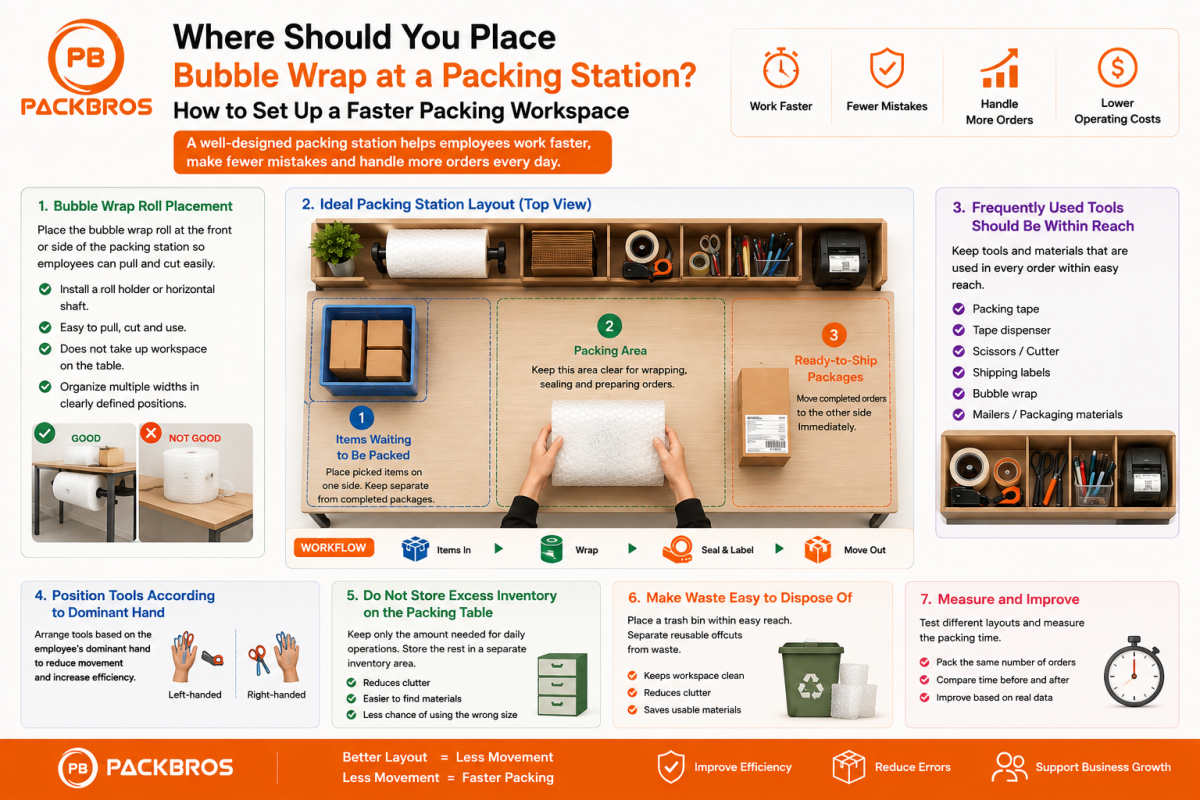
Where Should You Place Bubble Wrap at a Packing Station? How to Set Up a Faster Packing Workspace
As order volume increases, many businesses respond by hiring more packing staff.
However, sometimes the real problem is not a shortage of employees.
It is the packing station layout.
If employees have to turn around to get bubble wrap, walk several steps to pick up tape, search for cutters or repeatedly move packages around the workspace, a few wasted seconds per order can accumulate into hours of unnecessary work.
A good packing station should create a simple workflow:
Pick → Wrap → Seal → Move to Ready-to-Ship Area
The objective is to minimize unnecessary walking, reaching and repeated movements.
1. Where Should the Bubble Wrap Roll Be Placed?
Bubble wrap rolls are relatively large and are often used repeatedly throughout the day.
For this reason, they should not be stored somewhere employees have to walk to every time they pack an order.
A practical location is at the front or side of the packing table, where the employee can pull the bubble wrap directly into the working area.
For larger rolls, a roll holder or horizontal shaft can be installed along the edge of the table.
Employees can then pull out the required length and cut it without repeatedly lifting or moving the entire roll.
This also keeps large bubble wrap rolls from taking up valuable space on the tabletop.
If several bubble wrap widths are used, each width should have a clearly defined position so employees can quickly select the appropriate size.
2. Frequently Used Tools Should Be Within Easy Reach
Stand where the employee normally works and consider the area they can comfortably reach without walking or excessively twisting their body.
This is the most valuable area of the packing station.
Frequently used items such as:
- Packing tape
- Tape dispenser
- Scissors or cutter
- Shipping labels
- Bubble wrap
- Frequently used mailers or packaging materials
should be located within this area.
Backup materials and less frequently used supplies can be stored underneath the table, on shelves above the workstation, or in a separate inventory area.
The principle is simple:
The more frequently an item is used, the closer it should be to the employee.
3. Divide the Packing Table Into Three Zones
Instead of placing everything together, divide the packing station according to the workflow.
Zone 1: Items Waiting to Be Packed
Products that have already been picked should enter the packing station from one side.
They should not be mixed with completed packages, especially during high-volume periods when mistakes are more likely to occur.
Zone 2: Packing Area
The center of the table should remain as clear as possible.
This is where employees wrap products, place them into mailers or boxes, seal packages and prepare them for shipment.
Avoid using this area to store extra rolls of tape, tools or unnecessary supplies.
Zone 3: Ready-to-Ship Packages
Once an order is completed, the employee should be able to move it directly to the opposite side of the workstation.
This creates a continuous flow:
Incoming → Packing → Outgoing
rather than repeatedly moving products backward and forward.
4. Position Tools According to the Employee’s Dominant Hand
Even something as simple as the location of a tape dispenser can affect packing speed.
For a right-handed employee, frequently used tools may work better on the right side of the workstation.
For a left-handed employee, the layout can be reversed.
Not every packing table needs to be completely identical.
The important point is that tool placement should support the employee’s natural sequence of movements.
Ask an employee to pack 10–20 consecutive orders and observe the process.
Where do they cross their arms?
Where do they have to turn around?
Which tools require an uncomfortable reach?
Those are usually the first areas worth improving.
5. Do Not Turn the Packing Table Into an Inventory Storage Area
A packing table is a workspace, not a warehouse shelf.
For example, if a station normally uses only a few rolls of tape per day, there is little reason to keep an entire carton of tape on the table.
Keep only the amount required for normal operations and replenish it from inventory when necessary.
The same principle applies to bubble mailers.
If several sizes are used, organize them into clearly labeled compartments or shelves instead of stacking everything together.
This makes materials easier to access and reduces the risk of employees selecting the wrong size.
6. Make Packaging Waste Easy to Dispose Of
Waste-bin placement is another small detail that can have a surprisingly large effect on workflow.
If employees cannot easily dispose of plastic scraps, tape backing or other waste, these materials often end up on the table temporarily.
As the shift continues, usable workspace gradually becomes smaller.
A waste bin can therefore be placed underneath or beside the packing table where employees can reach it without leaving the station.
If larger pieces of bubble wrap can still be reused, consider having separate areas for:
Reusable offcuts and waste
This can prevent usable packaging material from being discarded unnecessarily.
7. Don’t Guess Which Layout Is Faster — Measure It
After changing the packing station layout, test it.
Choose the same type of product and compare the time required to pack the same number of orders.
For example:
Old layout: 20 orders = 35 minutes
New layout: 20 orders = 29 minutes
The new layout saves 6 minutes for every 20 orders.
At 200 orders per day, that difference could equal approximately 60 minutes of working time per day.
This demonstrates why relatively small improvements to a packing station can increase capacity without immediately adding another employee.
Example of a Simple Packing Station Workflow
A practical packing station can follow this sequence:
Items Waiting to Be Packed → Wrapping Area → Seal & Label → Ready to Ship
The bubble wrap roll can be mounted at the front or side of the wrapping area.
Tape, cutters and other frequently used tools should remain within easy reach.
Backup packaging materials can be stored underneath the table or on shelves.
Waste bins can be placed underneath or beside the station.
Completed packages should leave the work surface quickly so the next order can enter the packing process.
For businesses with several packing employees, it can also be useful to establish a consistent direction of product flow so employees are not constantly crossing paths during busy periods.
A Better Packing Station Does More Than Increase Speed
A well-organized packing station can also make other operational problems easier to identify.
For example, managers may notice that employees are using excessive bubble wrap, selecting the wrong mailer sizes, creating too much material waste, or repeatedly losing tools.
As order volume increases, a difference of only a few seconds per package becomes increasingly important.
Before hiring additional packing staff, it can therefore be worth asking:
Are employees spending their time packing products — or are they spending their time walking around and searching for supplies?
A good packing station allows employees to work continuously with minimal unnecessary movement while maintaining the required packaging quality.
PackBros is a manufacturer of bubble wrap and packaging materials in Thailand, supplying online sellers, wholesalers, factories and organizations with regular packaging requirements.
Selecting suitable bubble wrap sizes and packaging materials — together with an efficient packing station layout — can help businesses control costs and handle increasing order volumes more efficiently.
FAQ
Should a bubble wrap roll be placed on top of or underneath the packing table?
Large rolls do not necessarily need to sit on the tabletop. A roll holder can be installed at the front or side of the table so employees can pull the material directly into the working area.
How large should a packing table be?
There is no universal size. It should provide enough clear working space for the products most frequently packed without requiring employees to clear the table before every order.
How should multiple bubble wrap widths be organized?
Give each width a clearly defined position and place the most frequently used size in the easiest location to reach.
Can a packing station really reduce operating costs?
Yes, particularly by improving labor efficiency and reducing unnecessary movement. For high-volume operations, even a small reduction in packing time per order can create meaningful savings.
Should every packing station have exactly the same layout?
The overall workflow and operating standards can be consistent, while individual tool placement can be adjusted according to product type and employee working preferences.