

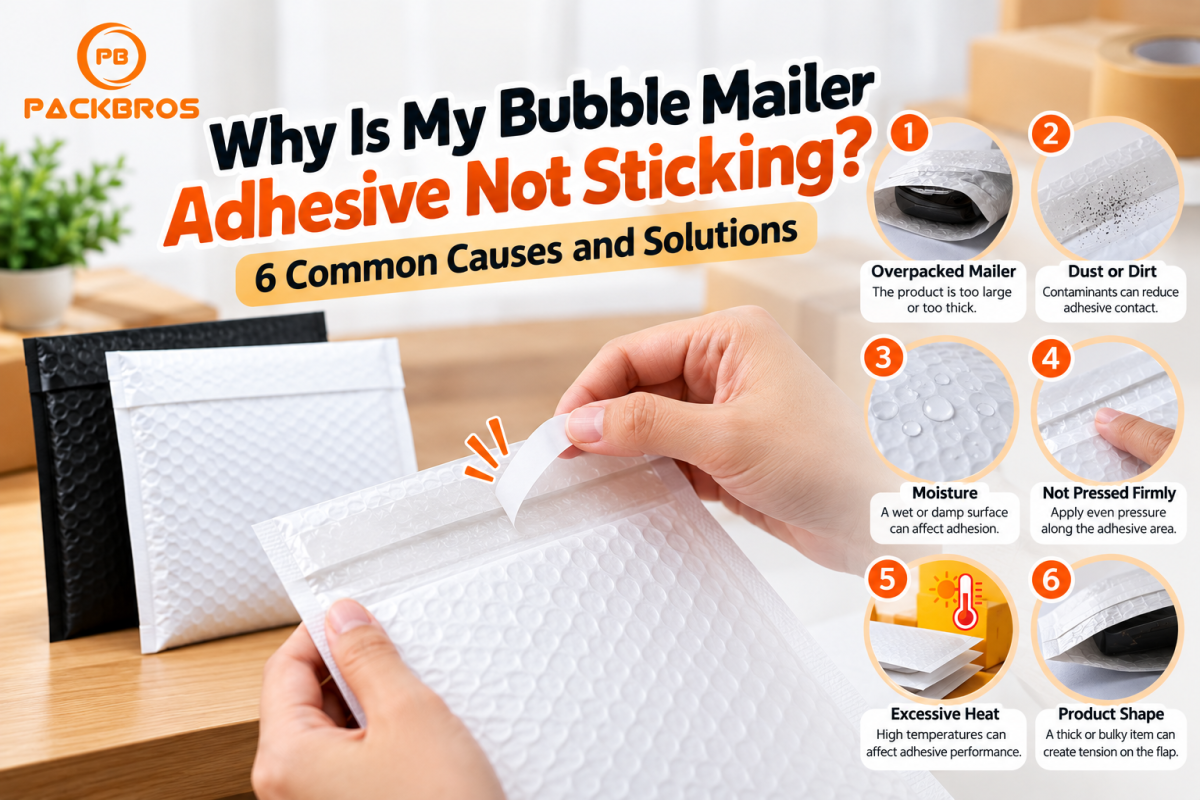
Why Is My Bubble Mailer Adhesive Not Sticking? 6 Common Causes and Solutions
Self-seal bubble mailers are widely used by online sellers, warehouses, and e-commerce businesses because they simplify the packing process. Instead of cutting packaging materials and applying additional tape, users can insert the product, remove the protective liner, and seal the adhesive flap.
However, some businesses encounter a frustrating problem: the bubble mailer adhesive does not stick properly, the flap keeps opening, or the seal becomes loose after packing.
Does this mean the adhesive is defective?
Not necessarily. Several factors can affect the performance of a self-seal bubble mailer, including product thickness, dust, moisture, storage conditions, and the way the flap is closed.
Understanding these factors can help businesses improve packaging reliability and reduce unnecessary repacking.
1. The Bubble Mailer Is Overpacked
One common reason an adhesive flap fails to stay closed is excessive tension around the opening.
When a product is too large or too thick for the mailer, the packaging stretches around the item. This creates continuous pressure on the adhesive flap.
Even if the adhesive initially sticks, the tension may gradually pull the flap open.
For example, a product measuring 15 × 20 cm may not fit comfortably inside a bubble mailer with the same dimensions if the product is several centimeters thick.
How to prevent this problem:
- Measure the product’s width, length, and thickness.
- Avoid forcing oversized products into smaller mailers.
- Check whether the flap closes without excessive tension.
- Test the actual product before ordering packaging in bulk.
For more information, read our guide: How to Choose the Right Bubble Mailer Size Without Wasting Money on Oversized Packaging.
2. Dust or Dirt Is Affecting Adhesion
Dust, paper particles, oil, and other contaminants can interfere with adhesive contact.
This issue may occur at busy packing stations where cardboard boxes, paper materials, and other packaging supplies are handled throughout the day.
When contaminants collect on the sealing surface, the adhesive may not bond properly.
How to prevent this problem:
- Keep packing tables clean.
- Avoid touching the adhesive strip unnecessarily.
- Remove the protective liner only when ready to seal.
- Ensure the sealing surface is free from visible contamination.
Maintaining a clean packing environment can help improve consistency when preparing large quantities of parcels.
3. Moisture Is Present on the Sealing Surface
Moisture can interfere with the performance of some pressure-sensitive adhesives.
If water droplets or condensation are present around the opening, the adhesive may not make sufficient contact with the mailer surface.
This is particularly relevant for businesses operating in humid environments or storing packaging near areas exposed to water.
How to prevent this problem:
- Keep unused bubble mailers in a dry storage area.
- Avoid sealing mailers while the surface is wet.
- Protect packaging supplies from rain and water exposure.
- Check the condition of stored packaging before use.
It is also important to distinguish between moisture resistance and complete waterproofing.
Learn more in our article: Are Bubble Mailers Waterproof? Will Your Products Get Wet in the Rain?.
4. The Adhesive Flap Was Not Pressed Firmly
Self-seal bubble mailers generally use pressure-sensitive adhesive, which requires proper contact with the sealing surface.
Simply folding the flap down may not always provide sufficient pressure across the entire adhesive area.
If only part of the adhesive strip makes contact, some sections may remain loosely attached.
How to prevent this problem:
- Insert the product into the mailer.
- Remove the protective release liner.
- Align the adhesive flap correctly.
- Fold the flap onto the sealing surface.
- Press firmly along the entire adhesive strip.
For businesses handling hundreds of shipments daily, a consistent sealing procedure can help reduce packing errors.
5. The Mailers Were Stored in Excessive Heat
Storage conditions can affect packaging materials, including certain adhesive formulations.
Prolonged exposure to excessive heat or direct sunlight may change adhesive properties and reduce sealing performance.
However, the effect depends on the adhesive formulation, storage temperature, and exposure duration.
Recommended storage practices:
- Store bubble mailers in a dry, shaded location.
- Avoid direct sunlight.
- Keep packaging away from excessive heat.
- Rotate inventory so older stock is used first.
- Follow the manufacturer’s recommended storage conditions when available.
These precautions are particularly useful for businesses purchasing packaging materials in large quantities.
6. The Product’s Shape Is Pushing Against the Flap
Two products with similar dimensions may create very different levels of pressure inside a bubble mailer.
A flat item generally distributes pressure differently from a thick, rigid, or irregularly shaped product.
For example, a bulky product may push outward against the opening and continuously pull on the adhesive flap.
This can cause the flap to lift even when the adhesive itself is functioning properly.
How to prevent this problem:
- Check whether the packed product stretches the opening.
- Avoid excessive pressure against the flap.
- Consider a larger mailer for thick or irregularly shaped products.
- Test the packed mailer before shipping.
For a detailed explanation, see How Thick Can a Product Be for a Bubble Mailer?.
Should You Use Additional Packing Tape?
Additional packing tape can be used when extra reinforcement is required.
However, if every bubble mailer needs extra tape to remain closed, businesses should investigate the underlying cause.
The problem may involve:
- Incorrect mailer dimensions
- Excessive product thickness
- Contaminated sealing surfaces
- Improper sealing procedures
- Unsuitable storage conditions
- Adhesive quality or manufacturing defects
Using tape may provide additional reinforcement, but it does not necessarily solve the original problem.
For high-volume operations, identifying the cause can help reduce unnecessary packing materials and repetitive work.
What Should Businesses Check Before Ordering Bubble Mailers in Bulk?
When purchasing thousands of bubble mailers, testing a sample before placing a large order is particularly important.
Businesses should evaluate:
Product fit: Does the product fit comfortably without stretching the mailer?
Adhesive performance: Does the flap remain securely closed under normal handling conditions?
Seam strength: Do the side and bottom seals remain intact?
Packing efficiency: Can employees seal the mailers consistently?
Storage requirements: Are the materials suitable for the expected storage environment?
Businesses requiring customized packaging should also confirm the adhesive flap dimensions, mailer construction, and intended application.
For additional guidance, read What Specifications Should You Provide When Ordering Custom Bubble Mailers in Bulk?.
Frequently Asked Questions (FAQ)
Why does my bubble mailer keep opening after I seal it?
A bubble mailer may reopen because the product is too thick, the sealing surface is contaminated, insufficient pressure was applied, or the product is creating tension around the opening. Adhesive quality can also be a factor.
Does humidity affect bubble mailer adhesive?
Humidity and moisture may affect certain adhesives, particularly when condensation or water is present on the sealing surface. The actual effect depends on the adhesive formulation and storage conditions.
Should I press the adhesive strip after closing the mailer?
Yes. Applying firm, even pressure along the adhesive area helps create consistent contact between the adhesive and the sealing surface.
Can an oversized product cause the adhesive flap to open?
Yes. An oversized or bulky product may stretch the mailer and place continuous tension on the flap, potentially causing the seal to lift.
Does a bubble mailer always need additional tape?
Not necessarily. A properly sealed self-adhesive mailer may not require additional tape for every application. However, extra reinforcement may be appropriate depending on the product and shipping requirements.
Can poor adhesive quality cause sealing problems?
Yes. Adhesive formulation, coating consistency, age, and manufacturing quality can influence sealing performance. If the flap continues to fail under appropriate packing and storage conditions, contact the supplier for further evaluation.
Conclusion
When a bubble mailer’s adhesive flap does not stay closed, the adhesive itself is not always the only possible cause.
Product dimensions, packaging tension, contamination, moisture, storage conditions, and sealing procedures can all influence the final result.
For online sellers and businesses handling large volumes of shipments, choosing suitable packaging and following a consistent sealing process can help reduce packing problems.
PackBros supplies white and black bubble mailers in multiple sizes for e-commerce sellers, warehouses, and businesses requiring packaging materials in bulk.
For wholesale inquiries, product specifications, or bulk quotations, visit PackBros Packaging.