

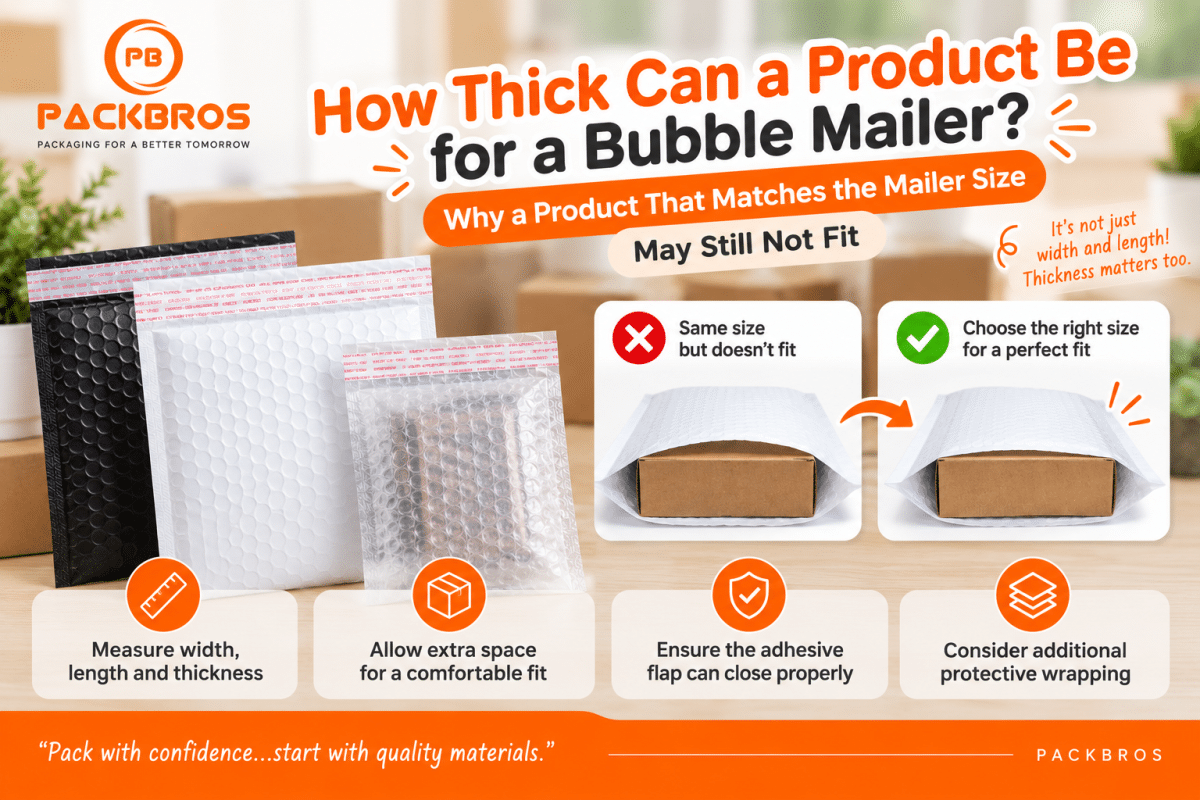
How Thick Can a Product Be for a Bubble Mailer? Why a Product That Matches the Mailer Size May Still Not Fit
When choosing a bubble mailer, many people measure only the width × length of the product and then select a mailer with similar dimensions.
However, when they try to insert the actual product, they may discover that it does not fit—or it fits so tightly that the adhesive flap becomes difficult to close.
The reason is simple:
Product thickness also takes up space inside the mailer.
For example, a product measuring 15 × 20 cm does not necessarily fit inside a 15 × 20 cm bubble mailer, especially if the product is several centimeters thick.
Why Doesn’t a 15 cm Wide Product Always Fit in a 15 cm Wide Mailer?
The dimensions listed for a bubble mailer generally describe the mailer while it is lying flat.
Once a three-dimensional product is inserted, part of the mailer’s material must wrap around the sides and thickness of the product.
This reduces the usable internal space.
Imagine two products with the same front dimensions:
Product A: 15 × 20 cm, thickness 0.5 cm
Product B: 15 × 20 cm, thickness 4 cm
Although their width and length are identical, they may require different mailer sizes.
This is why choosing a mailer based only on width and length can result in a mailer that looks correct on paper but is too small in actual use.
For a broader comparison of when mailers make sense for different packing operations, see Bubble Mailers vs Bubble Wrap Rolls. (packbrospackaging)
Measure Three Dimensions Before Choosing a Bubble Mailer
Instead of measuring only width and length, measure at least:
Width × Length × Thickness
Measure the product in the condition in which it will actually be packed.
For example, if the product will first be wrapped with tissue paper, protective film, bubble wrap, or another layer of packaging, measure it after those materials have been added.
The final packed dimensions are what matter when selecting the mailer.
How Much Extra Space Should You Allow?
There is no universal rule such as “always add 2 cm” or “always add 5 cm.”
The amount of additional space required depends on several factors, including product thickness, shape, rigidity, the construction of the mailer, and the sealed edges.
As product thickness increases, more of the mailer’s width is needed to wrap around the sides.
For high-volume orders, the safest approach is to test the actual product inside the proposed mailer before placing a large order.
The mailer should allow the product to slide in without excessive force while avoiding too much unnecessary empty space.
Don’t Choose a Mailer That Exactly Matches the Product
Suppose your product is 14 cm wide.
Choosing a 14 cm wide bubble mailer simply because the numbers match can create problems.
The product still has thickness, and the mailer may also have sealed edges that reduce the usable internal dimensions.
This is particularly important when ordering thousands of mailers.
A difference of only a few millimeters or centimeters can determine whether the packaging works efficiently—or becomes difficult to use across an entire production batch.
Is It Better to Choose a Much Larger Mailer?
Not necessarily.
Choosing a larger mailer gives you more room, but oversized packaging can also mean more material per package and a higher packaging cost per unit.
It may also leave excessive space around the product, allowing it to move inside the mailer.
For businesses packing hundreds or thousands of orders, the goal should not be to choose the largest mailer that will work.
A better objective is:
Choose the smallest practical mailer that allows the product to fit comfortably, close securely, and receive appropriate protection.
This becomes especially important when comparing bubble mailers with bubble wrap rolls for high-volume packing. See Bubble Mailers vs Bubble Wrap Rolls: Which Is More Cost-Effective for Your Business? for more details. (packbrospackaging)
Don’t Forget the Adhesive Flap
Getting the product inside the mailer is only part of the test.
You also need enough space to close the adhesive flap properly.
A thick or long product may technically fit inside the mailer but extend too close to the opening. When this happens, the adhesive flap may be difficult to fold over or may not seal correctly.
When testing a mailer size, complete the entire packing process:
Insert the product → position it properly → remove the adhesive liner → close and seal the mailer
Don’t stop the test simply because the product fits inside.
Can Bubble Mailers Be Used for Fragile Products?
It depends on the product.
Bubble mailers provide a cushioning layer, but they are not a replacement for a shipping box in every situation.
Highly fragile products, heavy items, glassware, ceramics, or products that cannot tolerate compression may require a box and additional protective packaging.
The packaging decision should therefore consider both product dimensions and the level of protection required, rather than mailer size alone.
You can also compare the strengths and limitations of mailers and bubble wrap in Bubble Mailers vs Bubble Wrap Rolls. (packbrospackaging)
Bubble Mailers Can Be Efficient for Repeated Packing
Bubble mailers can be particularly useful when a business repeatedly packs products of similar sizes.
Once the correct mailer size has been established, the packing process can become relatively simple:
Pick the mailer → insert the product → seal the flap
Traditional bubble wrap rolls may require additional steps such as measuring, cutting, wrapping, and applying tape.
This means businesses should consider not only the price of the packaging material, but also packing time and workflow efficiency.
For high-volume operations, even a small reduction in packing time per order can add up over hundreds or thousands of shipments.
What If Your Business Has Several Product Sizes?
You do not necessarily need one mailer size for every individual SKU.
However, using one oversized mailer for every product may also waste material.
One practical approach is to divide products into a few packaging groups, for example:
Small products → S mailer
Medium products → M mailer
Large products → L mailer
This keeps inventory manageable while reducing the amount of oversized packaging used for smaller products.
If your products require visibility through the packaging, clear bubble mailers can also be considered. PackBros discusses their applications in Products Best Suited for Clear Bubble Mailers: 10 Popular Uses for Online Sellers. (packbrospackaging)
What Should You Check Before Ordering Bubble Mailers in Bulk?
If you are planning to order thousands of mailers, test the actual product first.
Check whether:
The product slides in easily → the mailer is not excessively tight → there is not too much unused space → the adhesive flap closes properly → the packing process is practical for staff
This becomes even more important for custom-sized packaging.
Testing one sample before committing to a large production run can prevent a small sizing error from affecting thousands of mailers.
FAQ: Choosing Bubble Mailer Sizes
Can a 15 × 20 cm product fit in a 15 × 20 cm bubble mailer?
Not necessarily. You also need to consider product thickness. A three-dimensional product requires additional mailer material to wrap around its sides.
Do thicker products need larger bubble mailers?
Generally, yes. As thickness increases, more internal space is required. However, there is no single number of centimeters that should be added for every product.
Should I simply buy a much larger mailer to be safe?
You can, but oversized mailers may use more material, increase packaging costs, and leave unnecessary room for the product to move.
Does the adhesive flap count as part of the mailer length?
Check the manufacturer’s specifications. For example, a specification such as 20 × 30 + 4 cm should clearly indicate whether 20 × 30 cm refers to the body of the mailer and the additional 4 cm refers to the adhesive flap.
Should I test the size before ordering 10,000 mailers?
Yes. For large-volume or custom orders, testing the actual packed product is strongly recommended. A small sizing error can become a significant problem when repeated across an entire production batch.
Conclusion
When choosing a bubble mailer, don’t look at width × length alone.
Consider the product’s:
Width + Length + Thickness
You should also account for sealed edges, the adhesive flap, any additional protective material, and the actual packing process.
For businesses using bubble mailers in large quantities, testing the product in the proposed mailer before standardizing a size can improve packing efficiency, reduce unnecessary material use, and help control packaging cost per order.