

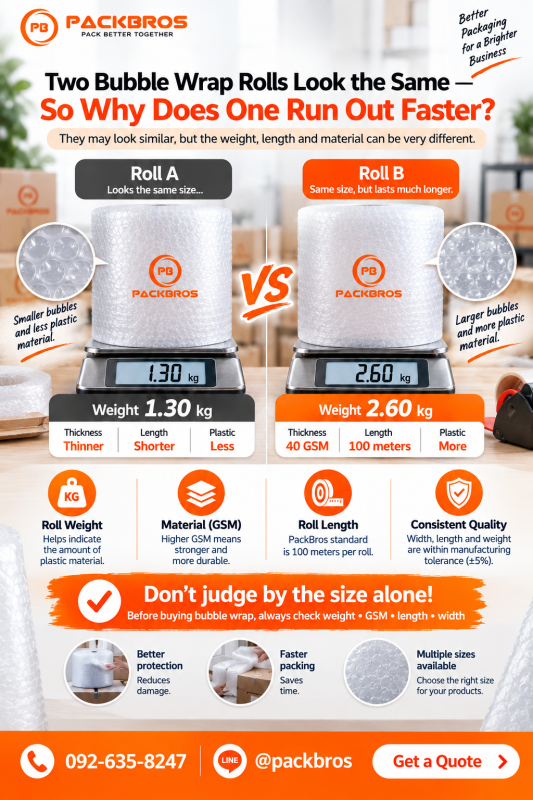
Two Bubble Wrap Rolls Look the Same — So Why Does One Run Out Faster?
When buying bubble wrap, many people compare products based on two things first:
The size of the roll and the price.
If two rolls look almost the same size and one is cheaper, the cheaper roll may appear to be the better deal.
But after using it, you may notice something strange:
Why does one bubble wrap roll run out much faster than the other?
The reason is that two bubble wrap rolls that look similar on the outside do not necessarily have the same specifications inside.
Their weight, GSM, length, width, and total amount of plastic material can be very different.
Why Can Two Similar-Looking Bubble Wrap Rolls Have Different Amounts of Material?
The outside diameter of a bubble wrap roll does not tell you exactly how much material you are buying.
For example, imagine two bubble wrap rolls with the same 65 cm width.
One roll weighs approximately 1.3 kg, while another weighs approximately 2.6 kg.
Even though the rolls may appear similar at first glance, there can be significant differences in:
Material quantity • GSM • Roll length • Roll weight
That is why businesses should not compare bubble wrap based only on how large the roll appears.
For a more detailed explanation of how roll weight can be used together with GSM and length when checking a 100-meter roll, read:
Is Your Bubble Wrap Really 100 Meters? Check the Weight Before Comparing Prices
PackBros’ existing English guide also explains that width, length, GSM and roll weight should be evaluated together rather than relying on weight alone. (Pack Bros Packaging)
1. Does Bubble Wrap Weight Matter?
Yes, but weight should not be considered alone.
If two rolls have the same width, length, GSM and construction, their weights can provide another useful reference for comparing the amount of material.
However, a heavier roll is not automatically better.
Weight should always be considered together with:
Width × Length × GSM × Product Construction
For example, comparing a 50 cm wide roll with a 65 cm wide roll based only on weight would not be meaningful because the amount of material required for each width is already different.
2. What Does GSM Mean in Bubble Wrap?
GSM stands for grams per square meter.
It represents the weight of material per unit of area and is an important specification when comparing bubble wrap.
For example, PackBros bubble wrap is specified at 40 GSM ±5%.
This means buyers have a measurable specification to compare instead of relying only on descriptions such as “thick,” “heavy,” or “premium.”
PackBros’ English article on checking 100-meter bubble wrap also lists reference weights of approximately 1.28 kg for 32.5 cm × 100 m × 40 GSM and approximately 2.6 kg for 65 cm × 100 m × 40 GSM. (Pack Bros Packaging)
3. Why Is Bubble Wrap Length So Important?
Because ultimately, businesses are not buying the appearance of a large roll.
They are buying usable packaging material.
A roll that looks large does not necessarily contain more meters of bubble wrap.
The visible size of the roll can be affected by factors such as material thickness, bubble structure, winding tension and construction.
Therefore, one of the most important questions to ask before buying is:
How many meters of bubble wrap are actually specified per roll?
PackBros bubble wrap is specified at 100 meters per roll, with a 40 GSM ±5% specification. (Pack Bros Packaging)
Knowing the roll length also makes it much easier to calculate packaging cost per order.
For example, if your business knows how many centimeters or meters are normally used for one product, you can estimate how many orders should be packed from one roll.
For a step-by-step calculation, see:
How Many Orders Can One Roll of Bubble Wrap Pack? Calculate Your Packaging Cost per Order
4. Does Bubble Wrap Width Affect Cost?
Yes — significantly, especially for high-volume packing operations.
Using bubble wrap that is much wider than the product may create unnecessary offcuts or require workers to fold excess material around the product.
Using bubble wrap that is too narrow can create the opposite problem: workers may need two pieces instead of one.
Both situations can increase material usage and packing time.
This is why the “cheapest roll” is not necessarily the roll that creates the lowest packaging cost per order.
PackBros has a separate English guide explaining this calculation:
What Bubble Wrap Width Is the Most Cost-Effective?
The guide explains that choosing an appropriate width can reduce excess material, unnecessary cutting and packing time. (Pack Bros Packaging)
5. Is Cheaper Bubble Wrap Actually Cheaper?
Not necessarily.
Imagine Bubble Wrap A costs THB 150 per roll and Bubble Wrap B costs THB 200.
If you compare only the selling price, A appears to save THB 50.
But what if the usable quantity is different?
Or what if one product requires more material per order to provide the protection you need?
This is why businesses that regularly use bubble wrap should look beyond:
“How much is one roll?”
and start asking:
“How much does this bubble wrap cost us per packed order?”
Useful measurements include:
Cost per meter
Cost per packed item
Material used per SKU
Number of orders packed per roll
Packing time per order
This is especially important when purchasing dozens or hundreds of rolls at a time.
6. How Can Businesses Reduce Bubble Wrap Waste?
One effective approach is to create a Packaging Standard for each SKU.
Instead of allowing each packing employee to estimate how much bubble wrap to use, businesses can determine an appropriate width and length for frequently packed products.
For example:
SKU A → 32.5 cm width × 60 cm per item
SKU B → 50 cm width × 1 meter per item
Once a suitable standard has been tested, workers can follow the same packing method.
This makes bubble wrap consumption easier to control and makes monthly material requirements easier to forecast.
7. What Should You Check Before Buying Bubble Wrap?
Before comparing prices from different suppliers, ask for these four specifications:
1. Width — How wide is the roll?
2. Length — How many meters are specified per roll?
3. GSM — What is the material weight per square meter?
4. Roll Weight — What is the approximate weight of the complete roll?
Only after checking comparable specifications does comparing the price per roll become meaningful.
If your business purchases bubble wrap in larger quantities, this English guide covers additional points worth checking before placing an order:
Buying Bubble Wrap in Bulk from a Factory: 7 Things Businesses Should Check Before Ordering
PackBros’ bulk-buying guide similarly recommends evaluating width, length, weight and material specification together rather than relying on a single measurement. (Pack Bros Packaging)
Similar Roll Size Does Not Mean the Same Specification
Two bubble wrap rolls can look almost identical from the outside while having very different specifications.
That is why comparing only roll size and price can be misleading.
Before deciding which bubble wrap offers better value, compare:
Width + Length + GSM + Roll Weight
Then calculate how much material your business actually uses per order.
The cheapest-looking roll is not necessarily the packaging option with the lowest actual cost.
Where Can I Buy 100-Meter Bubble Wrap in Thailand?
If you are searching for a bubble wrap manufacturer in Thailand, 100-meter bubble wrap, bulk bubble wrap supplier, or bubble wrap for factories and businesses, PackBros manufactures and supplies bubble wrap for e-commerce businesses, wholesalers, warehouses, manufacturers and corporate customers in Thailand. (Pack Bros Packaging)
PackBros bubble wrap is available in multiple widths with a standard specification of:
Length: 100 meters
Material specification: 40 GSM ±5%
For reference, a 65 cm × 100 m × 40 GSM roll weighs approximately 2.6 kg. (Pack Bros Packaging)
For bulk orders, product specifications or quotations:
PackBros
Tel: 098-851-3358
LINE: @packbros
Clear specifications make it easier to compare the real value of every roll.