
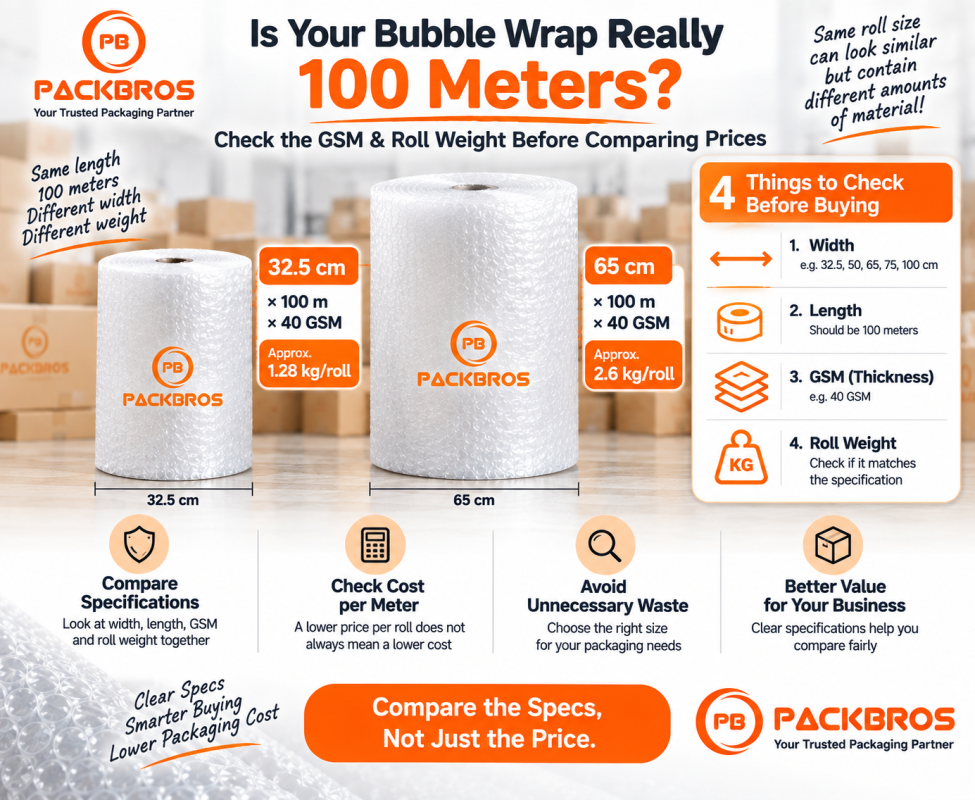
Is Your Bubble Wrap Really 100 Meters? Check the Weight Before Comparing Prices
When purchasing bubble wrap in bulk, many businesses, factories, and procurement teams start with one simple comparison:
Price per roll.
Supplier A offers a roll for THB 120.
Supplier B offers a roll for THB 100.
At first glance, the THB 100 roll appears to be the better deal.
But before comparing prices, there is a more important question:
Are you actually comparing the same specifications and quantity?
A product described as “1 roll” or “100 meters” does not provide enough information for an accurate cost comparison.
For a better comparison, check these four specifications together:
Width × Length × GSM × Roll Weight
Only after comparing similar specifications does the price per roll become meaningful.
Why Check the Weight If the Label Already Says “100 Meters”?
A stated length of 100 meters tells you the length specified by the manufacturer or supplier.
However, for businesses purchasing dozens or hundreds of rolls at a time, it is useful to check more than the stated length.
One important reference point is the weight of the roll.
If two bubble wrap rolls have the same:
Width
Length
GSM
then the amount of material and roll weight should generally correspond to those specifications, allowing for normal manufacturing tolerances.
Therefore, if two suppliers both describe their products as:
100 meters × 40 GSM
but the roll weights are significantly different, it is worth checking the specifications more carefully before assuming that the products contain an equivalent amount of material.
Don’t Rely Only on the Words “100 Meters”
This is particularly relevant when buying bubble wrap online.
Most buyers are not going to unroll an entire roll and manually measure all 100 meters every time a shipment arrives.
This is where roll weight becomes a useful reference point.
It does not mean that weight alone can prove the exact length of a roll. Weight is also affected by width, GSM, product construction, and other manufacturing variables.
Instead, weight should be checked together with the stated width, length, and GSM.
For procurement teams, this provides another way to evaluate whether the specifications appear consistent.
What Does 40 GSM Mean?
GSM stands for grams per square meter.
It represents the weight of material per unit of area.
Therefore, two bubble wrap rolls that are both described as 100 meters long are not necessarily equivalent if they have different GSM specifications.
For example, when requesting quotations from several suppliers, do not ask only:
“How much is one 100-meter roll?”
Instead, specify:
What width?
How many meters?
What GSM?
What is the approximate roll weight?
This makes supplier quotations much easier to compare.
Why Is Roll Weight Important for Procurement?
Suppose your procurement team receives quotations from three suppliers.
Each quotation describes the product as:
32.5 cm × 100 m × 40 GSM bubble wrap
The prices are different.
It may be tempting to immediately select the supplier offering the lowest price per roll.
Before doing that, ask each supplier for the approximate roll weight.
If the weights are reasonably consistent, that provides another useful reference point when comparing the specifications.
If there is a significant difference, ask additional questions such as:
Is the stated length the same?
Is the GSM specification the same?
Does the stated weight include the core?
A lighter roll does not automatically mean that the product is shorter than stated.
However, a large difference in weight is a good reason to verify the specifications before comparing prices.
Example: PackBros 100 m, 40 GSM Bubble Wrap
PackBros bubble wrap rolls are supplied with a main specification of:
100-meter length
40 GSM ±5%
10 mm bubble diameter
Examples of reference roll weights include:
32.5 cm × 100 m × 40 GSM
Approx. 1.28 kg per roll
65 cm × 100 m × 40 GSM
Approx. 2.6 kg per roll
Providing the length, GSM, width, and reference roll weight gives business customers more information for comparing specifications instead of relying only on the words “100 meters.”
A Roll That Is THB 10–20 Cheaper May Not Actually Cost Less
Consider two suppliers.
Supplier A: THB 120 per roll
Supplier B: THB 100 per roll
Based on price alone, Supplier B is THB 20 cheaper.
But before concluding that Supplier B offers the lower packaging cost, compare:
Is the width the same?
Is the actual length comparable?
Is the GSM the same?
Is the roll weight consistent with the stated specification?
If the amount of material supplied is different, comparing only THB per roll can produce a misleading cost comparison.
This becomes particularly important for companies purchasing 100, 300, or 500 rolls at a time, where small differences accumulate across the entire order.
Compare Cost per Meter, Not Only Cost per Roll
Another useful calculation is cost per meter.
For example, if a bubble wrap roll costs THB 120 and contains 100 meters:
THB 120 ÷ 100 m = THB 1.20 per meter
Now consider a different roll costing only THB 100, but suppose its verified usable length were 70 meters:
THB 100 ÷ 70 m = approximately THB 1.43 per meter
In this example, the roll with the lower purchase price actually has a higher cost per meter.
The point is not that inexpensive bubble wrap must contain less material.
The point is:
You need comparable specifications before you can determine which price is actually lower.
Four Questions to Ask Your Bubble Wrap Supplier
Before purchasing 100-meter bubble wrap in bulk, ask these four questions:
1. What is the roll width?
For example: 32.5, 50, 65, 75, or 100 cm.
2. What is the length per roll?
If you require 100 meters, specify this clearly in your RFQ.
3. What is the GSM?
The same stated length does not necessarily mean the same material specification.
4. What is the approximate weight per roll?
Use this as an additional reference when checking whether the specifications are consistent.
For B2B quotations, procurement teams should also check whether the quoted price includes VAT and delivery, so quotations from different suppliers are being compared under similar commercial terms.
Buying Hundreds of Rolls? Specifications Matter Even More
For a business purchasing one or two rolls, a small difference may have little impact on total packaging costs.
But if a factory or business uses:
100 rolls
300 rolls
or
500 rolls per order
small differences in price, length, material quantity, or specifications can become significant.
This is why procurement teams should establish a standard specification before requesting quotations.
Instead of asking suppliers:
“What is your price for one roll of bubble wrap?”
a more useful RFQ would be:
“Please quote 65 cm × 100 m × 40 GSM bubble wrap, including approximate roll weight.”
Now each supplier is quoting against a much clearer specification.
PackBros: Clear Specifications for Easier Comparison
At PackBros, we believe business customers should be able to compare bubble wrap based on clear product specifications, not price per roll alone.
Our bubble wrap specifications include key information such as:
100-meter length
40 GSM ±5%
Roll width
Reference weight by size
Because when purchasing bubble wrap in bulk, the question should not only be:
“How much is one roll?”
It should also be:
“What specification and quantity of bubble wrap am I actually getting for that price?”
Compare width + length + GSM + roll weight first.
Then compare the price.
Don’t choose bubble wrap based only on the lowest price per roll.
Compare what you actually receive in each roll.
For factories, procurement teams, wholesalers, and businesses requiring bubble wrap in volume, PackBros can provide product specifications, reference roll weights, and quotations based on order quantity and delivery location.