
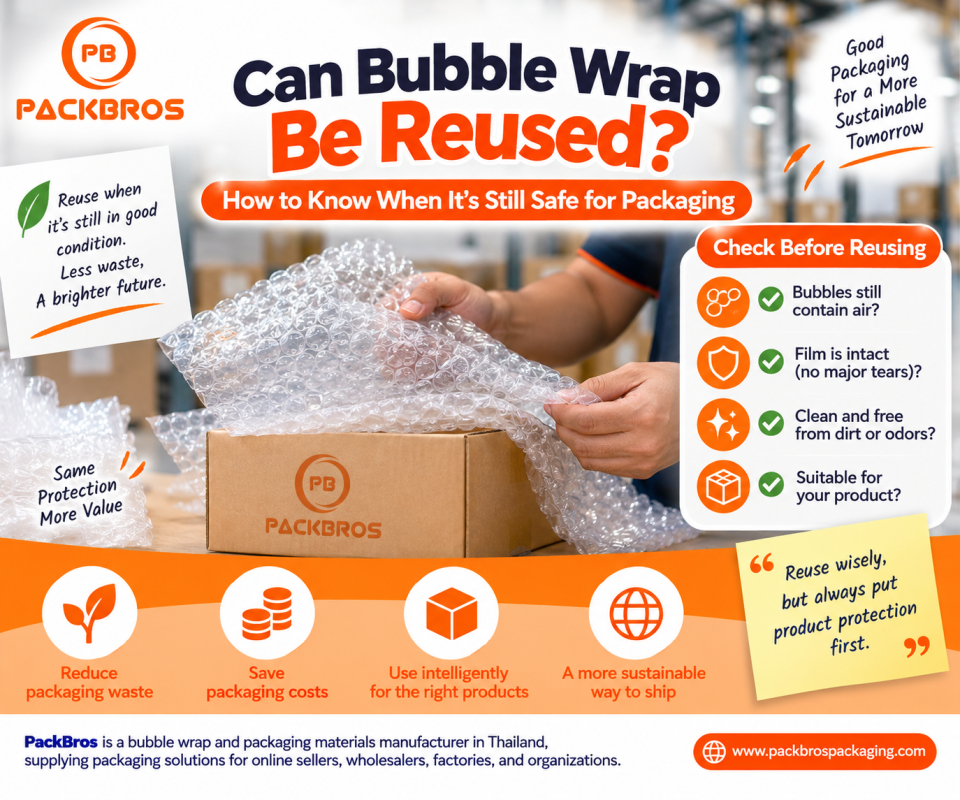
Can Bubble Wrap Be Reused? How to Know When It’s Still Safe for Packaging
Bubble wrap is often still in good condition after a package has been opened, which leads to a common question:
Can bubble wrap be reused for shipping?
In many cases, yes. Bubble wrap can be reused as long as the material is still in good condition and the air bubbles can provide sufficient cushioning.
However, not every piece of used bubble wrap should automatically be reused. Flattened bubbles, stretched film, tears, contamination, or previous compression can reduce its protective performance.
For online sellers, warehouses, and businesses that ship products regularly, knowing when bubble wrap can be reused and when it should be replaced can help reduce packaging waste without unnecessarily increasing the risk of product damage.
Can You Reuse Bubble Wrap?
Yes. Bubble wrap does not automatically become unusable after one shipment.
If most of the air bubbles remain inflated, the film is not badly stretched or torn, and the material can still create a cushioning layer around the product, it may be suitable for reuse.
The key is to evaluate its condition and intended application rather than simply counting how many times it has been used.
A piece of bubble wrap that has travelled once but remains in excellent condition may provide better cushioning than material that has been heavily compressed during storage.
1. Check Whether the Bubbles Still Contain Air
The first thing to inspect is the condition of the air bubbles.
Bubble wrap protects products by creating thousands of small air pockets between the item and external impact.
If most bubbles are still properly inflated, the material can usually continue providing cushioning.
A few popped bubbles do not necessarily make an entire sheet unusable. However, if large sections have become flat, the cushioning performance of those areas may be significantly reduced.
You can learn more about this in Is It Normal for Some Bubble Wrap Bubbles to Be Popped?
2. Check for Tears, Holes, and Stretched Film
Air bubbles are not the only thing to inspect.
Look at the plastic film itself.
If the material has become heavily stretched, torn, punctured, or damaged around the edges, it may not wrap securely around the next product.
Small imperfections may not matter for certain applications, but large tears can cause the bubble wrap to move or separate during transportation.
This becomes particularly important when packaging products with sharp corners or irregular shapes.
3. Check Whether the Bubble Wrap Has Been Permanently Compressed
Used bubble wrap may look acceptable at first glance but have already experienced considerable pressure during its previous shipment.
Gently press several areas with your fingers.
You should still be able to feel a noticeable layer of air and cushioning.
If the material feels mostly flat and provides little separation between your fingers and the surface underneath, its ability to absorb impact may have decreased.
4. Check Whether the Material Is Clean
Condition is not only about cushioning.
Before reusing bubble wrap, check whether it is clean and suitable for the next product.
Material that has been exposed to oil, chemicals, moisture, strong odors, dirt, or unknown substances may not be appropriate for reuse.
This is particularly important when packaging items where cleanliness and presentation matter.
For businesses shipping products directly to customers, the appearance of reused packaging should also be considered as part of the overall customer experience.
5. Consider What Product You Are Packing
Not every product requires the same level of protection.
For relatively durable, lightweight items, bubble wrap that has been used previously but remains in good condition may still be suitable.
However, greater caution should be taken with products such as:
- Glass bottles
- Ceramics
- Electronics
- Cosmetics
- Fragile accessories
- High-value products
- Products with sharp or vulnerable corners
For these products, consistent cushioning is more important because the cost of product damage may be significantly higher than the cost saved by reusing packaging material.
For additional guidance, see How to Pack Cosmetics for Shipping Without Broken Bottles or Damaged Boxes
How Many Times Can Bubble Wrap Be Reused?
There is no universal number of times that bubble wrap can safely be reused.
It depends on what happened to the material during each use.
For example, bubble wrap that was used around a lightweight item and experienced little compression may remain usable.
On the other hand, bubble wrap that was used around a heavy product, tightly compressed inside a package, or exposed to heat may deteriorate much faster.
Instead of setting a rule such as “use it two times” or “use it three times,” it is better to inspect the condition before every reuse.
A Simple Bubble Wrap Reuse Test
Businesses can create a simple inspection process for employees.
Before reusing bubble wrap, check three things:
Air – Film – Cleanliness
Air: Are most bubbles still inflated?
Film: Is the plastic still intact without excessive stretching or large tears?
Cleanliness: Is the material clean and suitable for the next product?
If all three conditions are acceptable, the bubble wrap may be suitable for reuse depending on the product being packed.
This simple rule can be particularly useful for warehouses where packaging materials are reused internally.
Reusing Bubble Wrap for Internal Packaging
There is an important difference between internal reuse and packaging that will be sent directly to customers.
For example, a factory may reuse bubble wrap when moving components between departments, protecting products inside a warehouse, or temporarily storing finished goods.
In these situations, appearance may be less important than functionality.
For customer-facing shipments, however, businesses may also need to consider presentation, cleanliness, and consistency.
Therefore, a company does not necessarily need one reuse policy for every packaging application.
When Should You Use New Bubble Wrap Instead?
Using new material may be more appropriate when the product is particularly fragile, valuable, heavy, or sensitive to damage.
New bubble wrap can also provide more consistent packaging when a business ships large volumes and wants employees to follow the same packing standard for every order.
Consistency becomes increasingly important as order volume grows.
If one employee uses new bubble wrap while another uses heavily compressed material, the level of protection between packages may vary considerably.
For businesses handling hundreds of orders, standardized packaging can therefore be just as important as the price of the packaging material itself.
Don’t Wrap Reused Bubble Wrap Too Tightly
Even bubble wrap that is in excellent condition can lose some of its cushioning ability if it is applied incorrectly.
Wrapping a product extremely tightly can compress the air pockets before the package is shipped.
The objective is to keep the material secure around the product while allowing the air bubbles to maintain their cushioning structure.
For more information, read How to Wrap Bubble Wrap Correctly: Should the Bubbles Face In or Out?
Reuse vs. Packaging Efficiency
Reusing packaging materials can reduce waste, but businesses should also consider labor efficiency.
Imagine an employee spending several minutes sorting old bubble wrap, removing tape, trimming damaged sections, and trying to find pieces large enough for each order.
The material itself may be free, but the process still has a labor cost.
For businesses shipping only a small number of packages, this may not matter much.
For businesses packing hundreds or thousands of products, however, saving a small amount of packaging material while adding significant packing time may actually increase the total cost per order.
This is why packaging decisions should consider more than simply the price of the material.
They should also consider:
Material cost + labor time + packing speed + product damage risk
Sometimes a Bubble Mailer May Be More Efficient
For small products with relatively consistent dimensions, repeatedly cutting, folding, wrapping, and taping bubble wrap may not always be the most efficient packaging method.
A ready-made bubble mailer can reduce the number of packing steps for certain products.
Whether this is more economical depends on product size, order volume, required protection, and labor costs.
Read more: Bubble Wrap vs. Bubble Mailer: Which One Is Better for Your Business?
Reusing Bubble Wrap Can Reduce Waste — But Protection Comes First
Reusing packaging materials can be a practical way to reduce unnecessary waste when the material remains usable.
However, reuse should not come at the expense of product protection.
For a business, the true cost of packaging is not simply the amount paid for bubble wrap.
If inadequate packaging results in a broken product, replacement shipment, refund, additional delivery cost, customer complaint, or negative review, the total loss can be much greater than the cost of using suitable packaging in the first place.
The objective should therefore be to reuse intelligently, not simply reuse as many times as possible.
Conclusion
So, can bubble wrap be reused?
Yes — in many situations, it can.
Before reusing it, check whether most bubbles still contain air, whether the film is intact, whether the material is clean, and whether it can still provide enough cushioning for the product being packed.
There is no fixed number of times that bubble wrap can be reused because its condition depends on how it was previously handled, compressed, transported, and stored.
For businesses, the best approach is to evaluate both protection and total packaging cost.
Reusing material can reduce waste, but for fragile, high-value, or standardized customer shipments, using bubble wrap in consistently good condition may be the better choice.
PackBros is a bubble wrap and packaging materials manufacturer in Thailand, supplying packaging solutions for online sellers, wholesalers, factories, and organizations.
Visit PackBros Packaging Products to explore available packaging materials and sizes.
FAQ
Can bubble wrap be reused for shipping?
Yes. Bubble wrap can be reused if most of the bubbles remain inflated, the film is in good condition, and the material is clean enough for the intended product.
How many times can I reuse bubble wrap?
There is no fixed number. Inspect the material before every use because its condition depends on the pressure, heat, handling, and transportation it has previously experienced.
Can I reuse bubble wrap with some popped bubbles?
Yes, if only a small number of bubbles are damaged and most of the surrounding area still provides adequate cushioning. Large sections of flat bubbles should be avoided for fragile products.
Should I reuse bubble wrap for fragile items?
It depends on its condition. For fragile or high-value products, use material that provides consistent cushioning. If used bubble wrap has significant compression or damage, replacing it with material in better condition may reduce shipping risk.
Is reusing bubble wrap always cheaper?
Not necessarily. Businesses should also consider the labor required to sort, clean, remove tape, cut, and prepare used material. For high-volume packing operations, labor time can affect the total packaging cost.
Is bubble wrap recyclable?
Recycling options depend on local collection systems and the type of plastic accepted. Bubble wrap is generally a flexible plastic material, so it may not be accepted in standard household recycling programs in every location. Check local recycling requirements before disposal.