
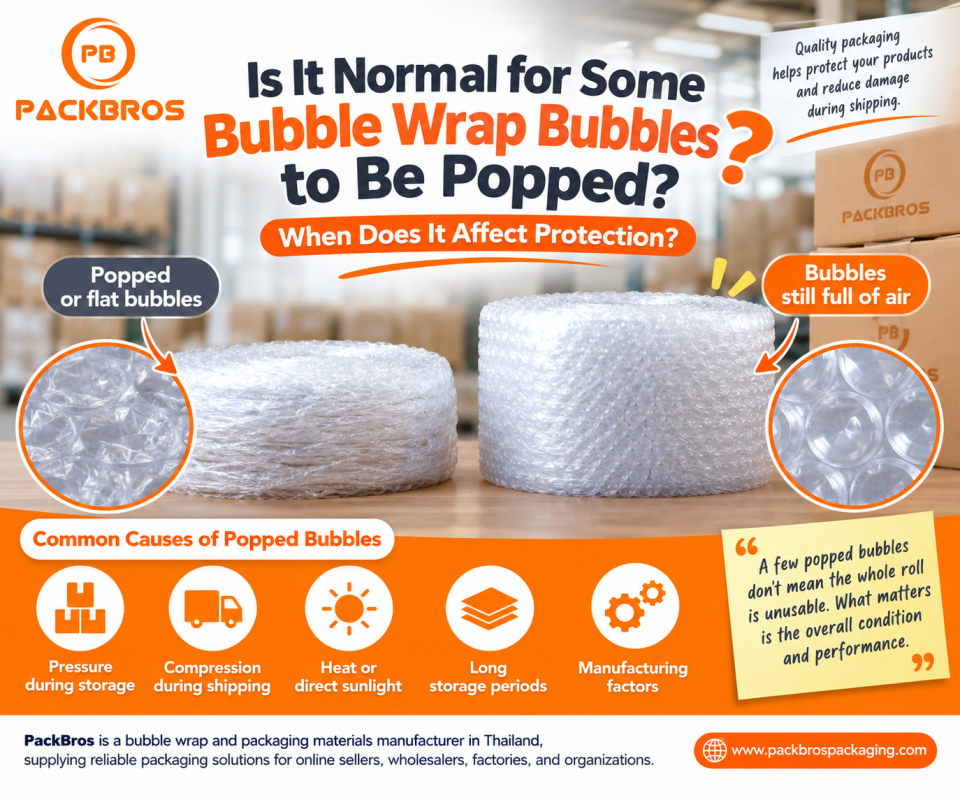
Is It Normal for Some Bubble Wrap Bubbles to Be Popped? When Does It Affect Protection?
When you unroll bubble wrap and notice that a few bubbles are popped, flat, or have lost their air, you may wonder whether the roll is defective or still safe to use for packaging.
The good news is that a few popped bubbles do not necessarily mean the entire roll is unusable.
Bubble wrap works through thousands of individual air pockets that create a cushioning layer around the product. Therefore, what matters most is not whether every single bubble is perfectly inflated, but how many bubbles are damaged, how the damage is distributed, and whether the remaining bubbles can still provide sufficient cushioning.
Are a Few Popped Bubbles Normal?
If only a small number of bubbles are flat or popped while most of the surrounding bubbles remain properly inflated, the bubble wrap can generally still be used.
This is because impact protection does not depend on one individual bubble. Instead, many air pockets work together to absorb and distribute pressure.
So rather than asking:
“Are there any popped bubbles?”
A better question is:
“Are there enough intact bubbles remaining to provide an effective cushioning layer?”
When Should You Be Concerned?
You should pay closer attention when a large number of bubbles are flat or deflated in the same area.
For example, if you unroll the material and find a wide section where most of the bubbles contain little or no air, that area may provide less cushioning than the rest of the sheet.
This is especially important when packaging fragile products.
Avoid placing heavily deflated sections directly around vulnerable areas such as corners, edges, bottle bases, glass surfaces, or other points that are likely to receive impact during transportation.
Why Do Bubble Wrap Bubbles Become Flat or Popped?
There are several possible reasons. Popped or deflated bubbles do not necessarily indicate a manufacturing problem.
1. Pressure During Storage
If heavy objects are placed on top of bubble wrap rolls, or if too many rolls are stacked together, prolonged pressure may compress some of the air pockets.
2. Compression During Transportation
Bubble wrap can also be compressed while being transported, especially when rolls are packed tightly together or placed next to heavier cargo.
The outer layers of a roll may therefore experience more pressure than the inner layers.
3. Improper Storage Conditions
Heat, direct sunlight, and long-term storage can affect the properties of polyethylene film.
Bubble wrap should ideally be stored in a dry, shaded area away from direct sunlight and excessive heat.
4. Long Storage Periods
Packaging materials should not be stored unnecessarily for very long periods, particularly under conditions involving heat or constant pressure.
Businesses that keep large inventories can use a FIFO (First In, First Out) system so older stock is used before newer stock.
5. Manufacturing Factors
Film properties, sealing quality, material formulation, and production conditions can also influence how well individual air pockets retain air.
However, when evaluating bubble wrap, it is more useful to examine the overall consistency of the material rather than judging an entire roll based on one or two individual bubbles.
Can Bubble Wrap Still Protect Products If Some Bubbles Are Popped?
Yes, provided that most of the bubbles in the area being used remain inflated and can still form an effective cushioning layer.
Think of bubble wrap as a large group of tiny air cushions working together.
If a few cushions fail, the surrounding ones can still provide protection. But when many adjacent bubbles lose their air, the cushioning performance of that particular area can decrease.
For this reason, bubble wrap should be evaluated based on the overall condition of the sheet, rather than a single bubble.
How to Check Bubble Wrap Before Using It
For online sellers, warehouses, and factories that use bubble wrap regularly, a simple inspection can be useful before packaging valuable or fragile products.
Unroll a section of the material and examine several different areas.
Gently press the bubbles with your fingers. Most should still contain air and provide noticeable cushioning.
If only a few individual bubbles are flat, the material can generally continue to be used.
However, if you notice large continuous areas where the bubbles are flat or have lost their air, avoid using those sections for products requiring a high level of protection.
Don’t Compress the Bubbles While Packing
Sometimes bubble wrap leaves the roll in perfectly good condition but becomes compressed during the packaging process itself.
Wrapping the material extremely tightly or applying excessive tape tension can flatten the air pockets before the parcel even begins its journey.
The goal should be to wrap the product securely without crushing the bubbles that provide the cushioning effect.
If you’re unsure how to position bubble wrap correctly around a product, read How to Wrap Bubble Wrap Correctly: Should the Bubbles Face In or Out?
Fragile Products Need Extra Attention
Products such as glassware, ceramics, bottles, cosmetics, and electronic equipment require greater protection.
For these products, avoid positioning sections with many deflated bubbles around the most vulnerable areas.
Use sections with properly inflated bubbles around corners, edges, and other impact-sensitive points.
It is also important to remember that bubble wrap is only one part of a complete packaging system.
Even perfectly inflated bubble wrap may not prevent damage if the product can move freely inside an oversized shipping box.
For more information, see How to Pack Cosmetics for Shipping Without Broken Bottles or Damaged Boxes
More Layers Do Not Automatically Mean Better Protection
A common assumption is that adding more layers of bubble wrap will solve any packaging problem.
Additional layers can provide more cushioning, but simply wrapping a product many times does not guarantee better protection.
The material should still contain sufficient air, cover vulnerable areas properly, and prevent the product from moving excessively during transportation.
The appropriate number of layers depends on factors such as the product’s weight, shape, fragility, and shipping conditions.
Choosing the Right Bubble Wrap Size Also Matters
Bubble wrap quality is important, but selecting the correct roll width can also affect packaging efficiency and cost.
If the roll is unnecessarily wide, employees may need to cut away excess material.
If the roll is too narrow, multiple pieces may be required to cover the same product, increasing both material usage and packing time.
Businesses that pack products every day should therefore consider both protection and packaging efficiency when selecting bubble wrap.
Read more: How to Choose the Right Bubble Wrap for Your Products
Good Bubble Wrap Does Not Mean Every Bubble Must Be 100% Identical
When evaluating bubble wrap quality, it is better to consider the overall consistency and performance of the material rather than focusing on a single air pocket.
For practical packaging applications, the important factors are whether most bubbles remain properly inflated, whether the film is suitable for the intended application, and whether the product is packed correctly.
For businesses using large quantities of packaging materials, establishing simple incoming-material and packing standards can also help maintain consistent packaging quality and control costs.
Conclusion
Finding a few popped or flat bubbles does not automatically mean that an entire roll of bubble wrap is defective or unusable.
What matters is the extent and distribution of the damaged bubbles.
If only a small number are affected and most surrounding bubbles remain inflated, the material can generally continue to provide cushioning.
However, if large continuous areas are flat or deflated, those sections should be avoided when packaging fragile or high-value products.
Ultimately, effective protection depends on choosing suitable bubble wrap, using it correctly, and evaluating the overall cushioning performance rather than judging the material by a single bubble.
PackBros is a bubble wrap and packaging materials manufacturer in Thailand, supplying packaging solutions for online sellers, wholesalers, factories, and organizations.
Visit PackBros Packaging Products to explore available packaging products and sizes.
FAQ
Can I still use bubble wrap if a few bubbles are popped?
Yes. If only a small number of bubbles are damaged and most surrounding bubbles remain inflated, the material can generally still be used.
What percentage of popped bubbles is considered unacceptable?
There is no single percentage that applies to every packaging application. The location and distribution of the damaged bubbles, product weight, fragility, and packaging method should all be considered. Large continuous areas of deflated bubbles should be avoided for fragile products.
Why do bubble wrap bubbles become flat?
Possible causes include compression during storage or transportation, excessive heat, long storage periods, and factors related to the film or manufacturing process.
Can bubble wrap with some popped bubbles still be used for fragile items?
It may still be suitable if the damage is minor. However, use sections with properly inflated bubbles around vulnerable parts of fragile products and add appropriate protection where necessary.
Does wrapping a product more tightly provide better protection?
Not necessarily. Wrapping too tightly can compress the air pockets and reduce their cushioning ability. Bubble wrap should fit securely around the product without crushing the bubbles.
SEO Title: Are Popped Bubbles in Bubble Wrap Normal?
Meta Description: Are a few popped bubbles in bubble wrap a problem? Learn when flat bubbles affect cushioning, what causes them, and how to check bubble wrap before packing.
Slug: are-popped-bubbles-in-bubble-wrap-normal