

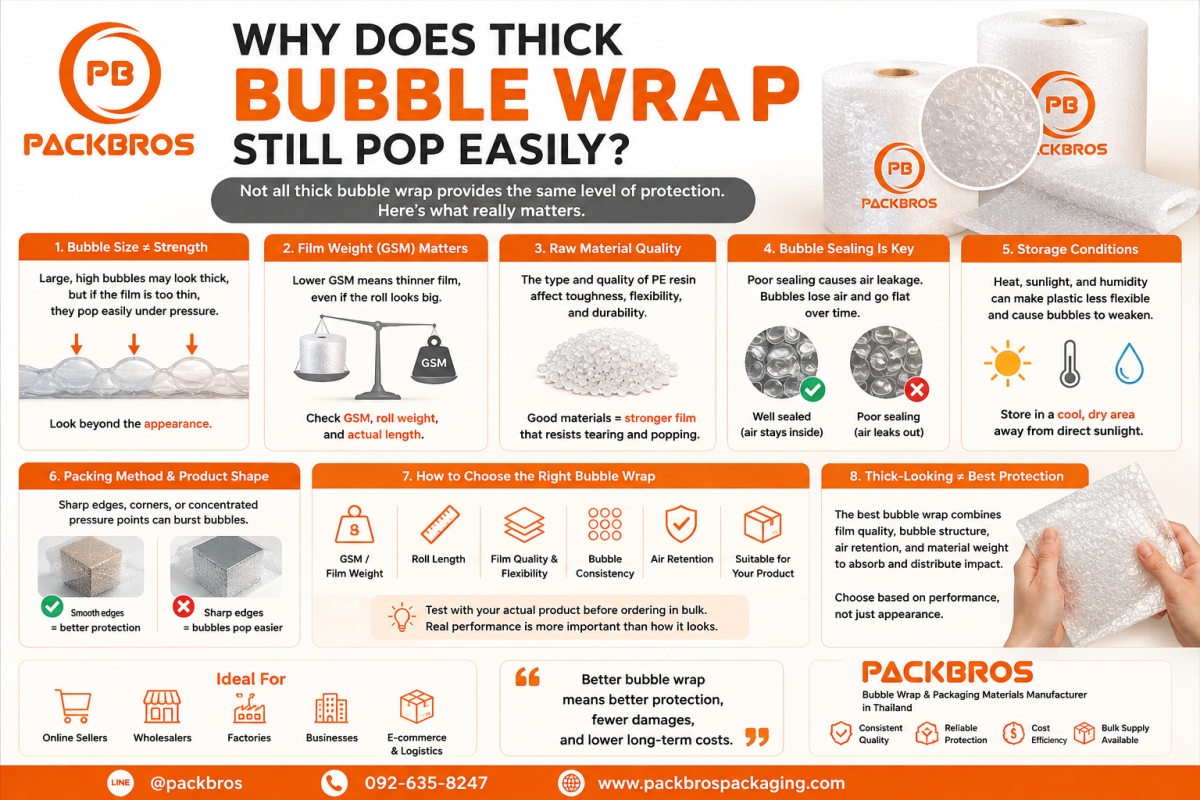
Why Does Thick Bubble Wrap Still Pop Easily?
Many buyers assume that the thicker the bubble wrap looks, the stronger the protection must be. However, this is not always the case.
Some bubble wrap may look thick, bulky, and full of air, but the bubbles can still pop or collapse easily when wrapped around a product, pressed during packing, or exposed to impact during transportation.
This happens because the visible thickness of bubble wrap is only one factor affecting its performance. Film weight, raw material quality, bubble sealing, manufacturing quality, storage conditions, and packing methods can all affect how well bubble wrap protects a product.
1. Large Bubbles Do Not Always Mean More Plastic
Bubble wrap can appear thick simply because the bubbles are inflated higher.
A roll with large, high bubbles may look impressive, but if the plastic film forming those bubbles is too thin, the bubbles may not withstand much pressure.
When the product is wrapped tightly or pressure is concentrated on a small area, the bubbles can collapse or pop more easily.
This is why buyers should not judge bubble wrap quality only by how thick or bulky the roll looks.
2. Film Weight Can Affect Bubble Strength
Another useful factor to consider is GSM (grams per square meter).
GSM represents the weight of material used per unit of area.
If two bubble wrap products have similar dimensions but one contains significantly less material per square meter, its film may be thinner.
This is one reason why some bubble wrap rolls look large and fluffy but feel surprisingly lightweight when picked up.
However, GSM alone does not determine quality.
A good evaluation should consider GSM, raw materials, film structure, bubble formation, and manufacturing quality together.
3. Raw Material Quality Matters
Bubble wrap is commonly manufactured from polyethylene (PE), but not every PE film has exactly the same properties.
The type and grade of raw materials, formulation, and production process can affect the flexibility, toughness, and durability of the finished film.
A suitable bubble film should have enough flexibility and toughness to withstand normal handling during packing.
If the film is too brittle, bubbles may break more easily when the material is stretched, folded, pressed, or wrapped around a product.
4. Bubble Sealing Is Extremely Important
Bubble wrap works by trapping air inside thousands of individual bubbles.
That trapped air helps create the cushioning effect that protects products from impact.
Therefore, even if the film itself appears thick, poor bubble formation or incomplete sealing can allow air to escape.
The bubble wrap may initially look full and firm but gradually become flatter during storage or use.
For this reason, good bubble retention is just as important as visible thickness.
5. Storage Conditions Can Affect Bubble Wrap
Bubble wrap does not remain unchanged forever.
Long-term exposure to high temperatures, direct sunlight, or unsuitable storage conditions can gradually affect the physical properties of plastic film.
Over time, the film may become less flexible or the bubbles may lose air more easily.
Businesses purchasing bubble wrap in large quantities should therefore consider not only the price and quantity but also how the material will be stored.
A cool, dry area away from direct sunlight is generally more suitable for storing packaging materials.
6. Sometimes the Problem Is the Packing Method
Not every popped bubble is caused by poor-quality bubble wrap.
Products with sharp corners, pointed edges, protruding components, or concentrated pressure points can put significant force onto a very small section of the bubble film.
Instead of distributing pressure across many bubbles, the force may be concentrated on only a few bubbles, causing them to burst.
For products like these, businesses may need to reinforce vulnerable areas, add additional cushioning, or use multiple protective materials together.
How Should You Choose Bubble Wrap?
Instead of asking only:
“Which bubble wrap is thicker?”
Consider several factors together:
- GSM or film weight
- Roll weight
- Actual roll length
- Film toughness and flexibility
- Bubble consistency
- Air retention
- Raw material quality
- Suitability for the product being packed
For businesses purchasing large quantities, one of the best approaches is to test the bubble wrap with the actual product before placing a large order.
Wrap the product as it would normally be packed, apply pressure to typical impact points, and observe whether the bubbles collapse too easily.
Thick-Looking Bubble Wrap Is Not Always Better Bubble Wrap
The primary purpose of bubble wrap is to absorb and distribute impact before that force reaches the product.
Therefore, the best bubble wrap is not necessarily the one that looks the thickest.
What matters is whether the combination of film quality, bubble structure, air retention, and material weight provides suitable protection for the intended application.
For businesses using packaging materials regularly, comparing products based on actual specifications and performance can provide a much better picture than simply comparing appearance or price per roll.
Bubble Wrap for Online Sellers, Wholesalers, Factories and Businesses
PackBros is a bubble wrap and packaging materials manufacturer in Thailand, supplying packaging solutions for online sellers, wholesalers, factories, organizations, and businesses with regular packaging requirements.
Choosing bubble wrap with appropriate specifications can help businesses achieve more consistent packing quality, reduce unnecessary product damage, and better control packaging costs.
Frequently Asked Questions (FAQ)
Are larger bubbles stronger than smaller bubbles?
Not necessarily. Bubble size is only one factor. Film strength, material quality, bubble structure, and air retention also affect overall performance.
Why does some bubble wrap pop very easily?
Possible reasons include thin film, unsuitable raw material properties, weak bubble sealing, aging of the material, improper storage, or concentrated pressure from sharp product edges.
Does higher GSM always mean stronger bubble wrap?
Not always. GSM indicates material weight per square meter, but overall strength also depends on the raw materials, film formulation, bubble structure, and manufacturing process.
How can businesses test bubble wrap before ordering in bulk?
Use the bubble wrap with the actual product. Test normal wrapping, folding, pressure, and vulnerable corners, and check whether the bubbles retain air and provide adequate cushioning.
Can bubble wrap still protect products after the bubbles have collapsed?
Its cushioning performance will generally be reduced because the trapped air inside the bubbles is an important part of its impact-absorbing function.