
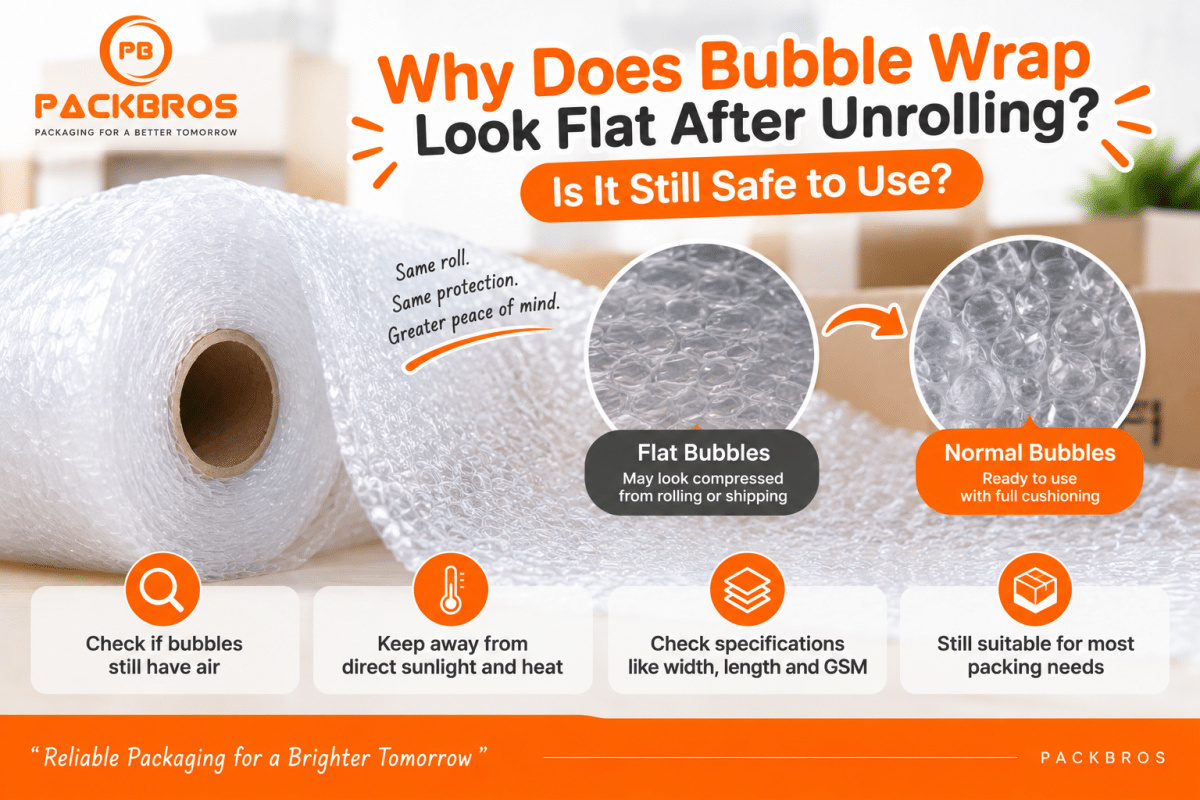
Why Does Bubble Wrap Look Flat After Unrolling? Is It Still Safe to Use?
You open a new roll of bubble wrap and notice that some of the bubbles look flatter than expected. Some areas may appear fully inflated, while others look slightly compressed.
Does this mean the bubble wrap is damaged?
Not necessarily.
Bubble wrap can look slightly flat after being tightly rolled, stacked, stored, or transported. The more important question is whether the bubbles still contain air and provide resistance when pressed.
Understanding the difference between a temporarily compressed bubble and a leaking bubble can help you decide whether the material is still suitable for packing.
Why Can Bubble Wrap Look Flat After Unrolling?
Bubble wrap is stored as a tightly wound roll. Multiple layers of material are pressed against one another while the roll is being stored and transported.
Because of this pressure, some bubbles may appear less rounded immediately after the material is unrolled.
Large rolls can also experience additional compression when they are stacked during transportation or storage.
A bubble that looks slightly compressed, however, is not automatically the same as a bubble that has lost its air.
Compressed Bubble vs. Leaking Bubble: What’s the Difference?
A simple way to check bubble wrap is to gently press several bubbles in different areas of the sheet.
If a bubble still feels inflated and provides resistance when pressed, air is still trapped inside it.
If the bubble is completely flat, provides almost no resistance, or large sections of the sheet have lost their cushioning structure, the bubbles may have leaked or been damaged.
The key distinction is:
Compressed appearance ≠ automatically damaged
but
Loss of trapped air = reduced cushioning performance
This is why visual appearance alone may not be enough to judge the condition of bubble wrap.
Should Every Bubble Look Exactly the Same?
Not necessarily.
Bubble wrap is a manufactured plastic cushioning material, and minor variation can occur across a roll.
Rather than judging quality only by whether every bubble looks visually identical, consider several factors together:
- Whether the bubbles retain air
- Whether the material provides cushioning
- Roll width
- Roll length
- Material weight or GSM
- Number of layers
- Overall consistency across the roll
For businesses purchasing bubble wrap regularly, checking measurable specifications is generally more useful than judging the roll only by its outside diameter.
You can read more in Why Two 100-Meter Bubble Wrap Rolls Can Have Different Weights.
Can Storage Conditions Affect Bubble Wrap?
Yes.
Where and how bubble wrap is stored can affect the plastic over time.
Exposure to direct sunlight, UV radiation, and excessive heat can accelerate the deterioration of plastic materials. This may eventually affect flexibility, strength, and overall performance.
For better storage, bubble wrap should generally be kept:
- Indoors
- Away from direct sunlight
- Away from excessive heat
- In a dry storage area
- In a position that avoids unnecessary crushing or heavy loads
For more details, see Can Bubble Wrap Be Exposed to Sunlight? Why Does It Deteriorate Faster in the Sun?.
Can Slightly Flat Bubble Wrap Still Be Used?
If the bubbles still contain air and provide resistance when pressed, slightly compressed-looking bubble wrap may still be usable.
However, the decision should also depend on what you are packing.
A lightweight, non-fragile product does not have the same protection requirements as glassware, ceramics, electronics, or other fragile products.
If a large area of the bubble wrap has lost its air, the cushioning performance will be reduced, and it may not be appropriate for products requiring higher protection.
Why Is the Air Inside the Bubbles Important?
The protective function of bubble wrap comes largely from the small pockets of trapped air.
When an impact occurs, these air-filled bubbles help create a cushioning layer between the product and the external force.
If a large number of bubbles have already lost their air, there is less cushioning structure available to absorb or distribute that force.
This is why bubble condition matters more than simply looking at how thick the roll appears.
Does a Bigger-Looking Roll Mean Better Bubble Wrap?
Not always.
Two rolls may appear similar in diameter but have different specifications.
Roll appearance can be affected by how tightly the material is wound, the amount of plastic used, the width, the length, and the structure of the material.
For this reason, businesses comparing suppliers should check the actual specification rather than relying only on photographs or the apparent size of the roll.
This is especially important when comparing products advertised as the same length.
Read more: Why Two 100-Meter Bubble Wrap Rolls Can Have Different Weights.
What Should Businesses Check When Receiving Bubble Wrap?
If your business uses bubble wrap regularly, a simple incoming inspection can help identify problems before the roll reaches the packing station.
Check several areas of the roll rather than only the outside layer.
You can inspect:
Bubble condition → Width → Roll length/specification → Material consistency → Signs of heat or storage damage
If you purchase the same specification repeatedly, keeping a reference sample can also make it easier to identify unusual differences between deliveries.
How Should Bubble Wrap Be Stored in a Warehouse?
Bubble wrap takes up significant storage space because most of its volume is air.
It may be tempting to stack or compress rolls heavily to save warehouse space, but excessive pressure can affect the bubbles.
Ideally, rolls should be stored in a clean, dry area and protected from direct sunlight and high temperatures.
Businesses that keep several weeks of packaging inventory should also rotate stock so older rolls are used before newly delivered stock.
If you operate a dedicated packing station, you may also find Where Should You Place Bubble Wrap at a Packing Station? useful for organizing daily packing operations.
What Specifications Should You Check When Buying Bubble Wrap?
Price per roll should not be the only comparison.
Check:
Roll width — Is it suitable for the products you normally pack?
Roll length — How much material are you actually receiving?
GSM — How much material is used per square meter?
Number of layers — How is the bubble wrap constructed?
Bubble consistency — Are the bubbles retaining air across the sheet?
Supplier specification tolerance — Is a manufacturing tolerance clearly stated?
PackBros bubble wrap rolls are produced at 100 meters per roll with a 40 GSM specification (±5%), with multiple widths available for different packing requirements.
FAQ: Flat or Compressed Bubble Wrap
My new bubble wrap looks slightly flat. Is it defective?
Not necessarily. Bubble wrap may become temporarily compressed while tightly rolled, stacked, or transported. Check whether the bubbles still contain air and provide resistance when pressed.
How can I tell if a bubble has leaked?
Press the bubble gently. If it is completely flat and provides little or no resistance, the air may have escaped.
Can I still use bubble wrap if a few bubbles are damaged?
A small number of damaged bubbles does not necessarily make the entire sheet unusable. However, widespread loss of air will reduce cushioning performance and should be considered when packing fragile products.
Does sunlight damage bubble wrap?
Long-term exposure to sunlight and UV radiation can accelerate plastic degradation. Bubble wrap should therefore be stored away from direct sunlight whenever possible.
Should I compare bubble wrap by roll size?
Not by appearance alone. Two rolls that look similar can have different lengths, widths, GSM, material quantities, or winding tightness. Check the actual specifications.
Conclusion
Bubble wrap that looks slightly flat after being unrolled is not automatically damaged.
The important question is whether the bubbles still contain air and provide cushioning resistance.
When evaluating bubble wrap—especially for business use—consider the condition of the bubbles together with roll length, width, GSM, material construction, and storage conditions rather than judging quality only by how large or fluffy the roll looks.
For businesses using packaging every day, consistent specifications can also make it easier to control both product protection and packaging cost.