

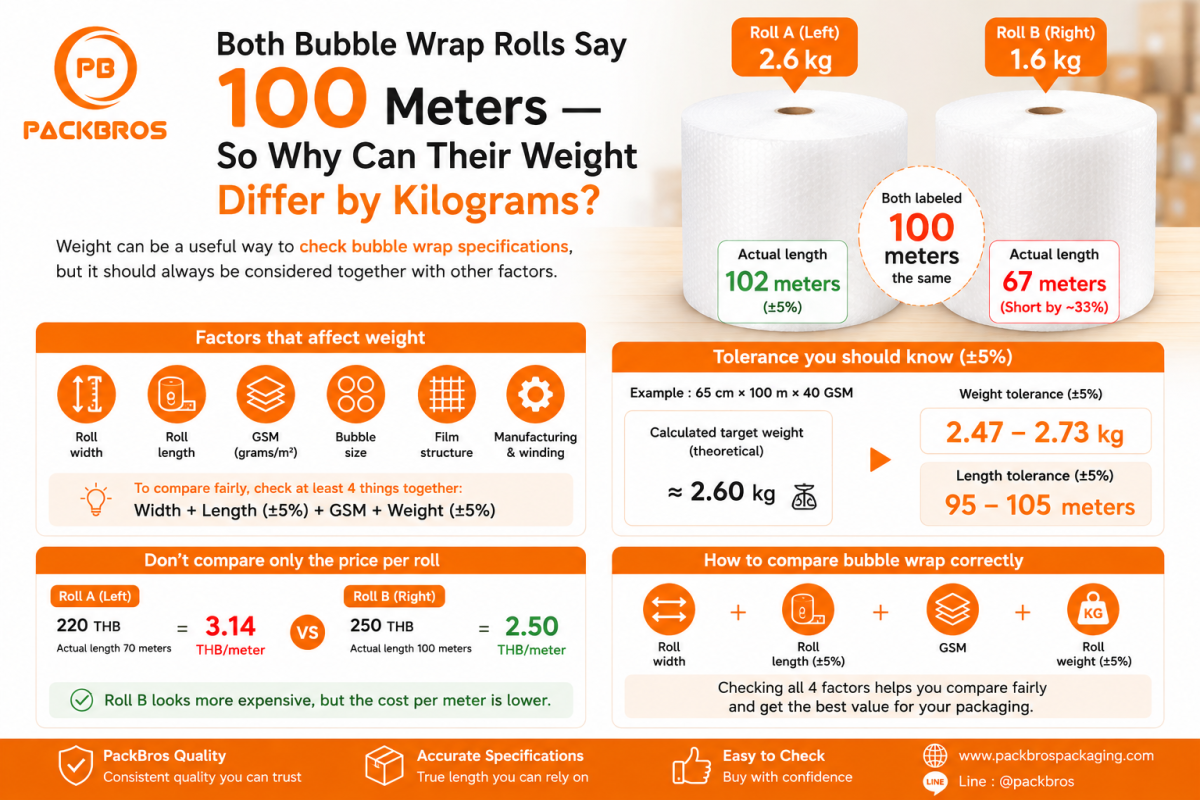
Both Bubble Wrap Rolls Say 100 Meters — So Why Can Their Weight Differ by Kilograms?
When buying bubble wrap rolls, many buyers compare only three things: width, length, and price. In particular, the label “100 meters” often becomes the main point of comparison.
But have you ever compared two bubble wrap rolls that are both labeled 100 meters long and have the same width, only to find that one roll is significantly heavier than the other?
In some cases, the difference can be several hundred grams — or even more than one kilogram.
So why does this happen? Does a lighter roll mean that it is not actually 100 meters long?
The answer is: weight can be a useful way to check bubble wrap specifications, but it should always be considered together with other factors.
Why Can Two 100-Meter Bubble Wrap Rolls Have Different Weights?
First, it is important to understand that two rolls labeled 100 meters do not necessarily have to weigh exactly the same.
The weight of a bubble wrap roll depends on several factors, including:
- Roll width
- Actual roll length
- GSM (grams per square meter)
- Film thickness
- Bubble size
- Film structure
- Manufacturing and winding conditions
Therefore, if two products have different specifications, their weights can be different even if both are genuinely close to 100 meters long.
However, if two rolls have the same width, similar GSM, and the same stated length, but their weights differ significantly, it may be worth checking the specifications more carefully.
What Does GSM Have to Do With Bubble Wrap Weight?
GSM stands for Grams per Square Meter. It indicates the approximate amount of material used per square meter.
For example, consider a bubble wrap roll with the following specifications:
65 cm width × 100 m length × 40 GSM
The total area is approximately:
0.65 × 100 = 65 m²
At 40 GSM:
65 × 40 = 2,600 grams
or approximately:
2.60 kg
This means that when you know the width + length + GSM, you can estimate how much material should be present in the roll.
However, this is a theoretical calculation. Actual production can vary within normal manufacturing tolerances.
Why Should You Weigh a Bubble Wrap Roll?
For businesses that purchase bubble wrap in volume, unrolling every roll to measure its full length is obviously inconvenient.
Imagine receiving 50 or 100 rolls and having to unroll each one just to check whether the length is close to the stated specification.
This is why weighing the roll can be a practical preliminary quality-control method.
Once you know the normal weight range for a particular bubble wrap specification, you can randomly weigh rolls from each production lot.
If the weight is close to the expected range, it provides another useful indication that the amount of material is reasonably consistent with the specification.
If the weight is significantly lower than expected, further investigation may be needed to determine whether the difference comes from:
Lower GSM, different film construction, or actual roll length.
If Two Rolls Differ by 1 kg, Does That Mean One Is Shorter?
Not necessarily.
For example, suppose two bubble wrap rolls are both labeled:
65 cm × 100 m
Roll A weighs approximately 2.5–2.6 kg.
Roll B weighs approximately 1.5–1.7 kg.
That is a significant difference.
However, you should not immediately conclude that Roll B is shorter.
The first thing to check is whether both products have the same GSM and film specifications.
A lower-GSM bubble wrap uses less plastic material per square meter and can therefore weigh considerably less even if the actual length is similar.
However, if both products have approximately the same width, stated length, GSM, and film structure, yet the weight difference remains unusually large, then the actual length is one of the factors worth checking.
This is why roll weight should be treated as a cross-checking tool rather than absolute proof of length.
Allow Approximately ±5% Manufacturing Tolerance
Real-world manufacturing cannot produce every bubble wrap roll at exactly the same numerical value.
For preliminary inspection, an approximate ±5% tolerance can be considered for both length and weight.
For example:
100 meters ±5%
corresponds to an approximate inspection range of:
95–105 meters
Similarly, if the calculated target weight is:
2.60 kg
a ±5% range would be approximately:
2.47–2.73 kg
Therefore, a small difference in length or weight does not automatically mean that the product is outside its expected specification.
What buyers should pay attention to is a large or unusual difference compared with products of the same specification.
A Bigger-Looking Roll Does Not Always Mean a Longer Roll
Another common mistake is comparing bubble wrap simply by looking at the outside diameter of the roll.
A bigger-looking roll does not necessarily contain more meters.
The apparent size of a bubble wrap roll can be affected by several factors:
- Winding tension
- Air volume inside the bubbles
- Bubble size
- Film thickness
- How tightly or loosely the roll is wound
A loosely wound roll may look much larger, while a tightly wound roll may look smaller even if their actual lengths are similar.
Therefore, visual roll size alone is not a reliable way to determine the actual length.
What Should You Compare When Buying Bubble Wrap?
For a more accurate comparison, buyers should consider at least four specifications together:
Width + Length ±5% + GSM + Weight ±5%
When these figures are available, it becomes much easier to compare bubble wrap products fairly.
For example, if two suppliers claim similar width, length, and GSM, but one product weighs significantly less, the difference provides a reason to investigate the specifications further.
The purpose of weighing is not to argue over a few grams.
It is to determine whether the amount of material received is reasonably consistent with the stated product specification.
Don’t Compare Only the Price per Roll — Compare the Cost per Meter
For e-commerce sellers, wholesalers, factories, fulfillment operations, and other businesses that use large quantities of bubble wrap, the most important question should not simply be:
“How much does one roll cost?”
A better question is:
“How many usable meters of bubble wrap am I actually getting for the money?”
For example, suppose Roll A costs THB 220, but after measuring it, the actual length is only 70 meters.
The cost per meter would be:
220 ÷ 70 = THB 3.14/meter
Now suppose Roll B costs THB 250, but its measured length is approximately 100 meters.
The cost per meter would be:
250 ÷ 100 = THB 2.50/meter
Although Roll B costs THB 30 more per roll, its cost per meter is actually lower.
This is why the cheapest price per roll does not always mean the lowest packaging cost.
Why Does This Matter for High-Volume Buyers?
For one roll, a difference of 20 or 30 meters may not seem significant.
But the situation changes quickly when a business uses dozens or hundreds of rolls every month.
For example, a difference of:
30 meters per roll × 100 rolls = 3,000 meters
That is 3 kilometers of bubble wrap.
For an e-commerce seller, wholesaler, factory, or fulfillment operation using packaging materials every day, this difference can have a significant impact on monthly packaging costs.
This is why checking the actual specifications can be just as important as negotiating the purchase price.
PackBros Focuses on Verifiable Specifications
PackBros is a manufacturer of bubble wrap and packaging materials in Thailand, supplying packaging solutions for e-commerce businesses, wholesalers, factories, organizations, and customers looking for reliable packaging materials.
We believe buyers should be able to compare bubble wrap using measurable information rather than relying only on the advertised price or the visual size of the roll.
Roll weight is one practical indicator that can help determine whether the amount of material in each roll is reasonably consistent with its specifications, while allowing for an approximate ±5% manufacturing tolerance.
For businesses purchasing packaging materials in volume, knowing the width, length, GSM, weight, and cost per meter makes it much easier to evaluate the true value of each product.
A roll that appears more expensive at first may actually provide a lower cost per meter and lower packaging cost in the long run.
Conclusion
Two bubble wrap rolls labeled 100 meters can have significantly different weights, but this does not automatically mean that the lighter roll is shorter.
To make a fair comparison, check:
Width + Length ±5% + GSM + Weight ±5%
If all major specifications are similar but the weight difference is unusually large, it may be worth checking the actual length or other product specifications.
Most importantly, businesses should not evaluate bubble wrap based only on the price per roll.
Before placing your next order, ask:
What is the width?
What is the stated length?
What is the GSM?
What is the approximate roll weight?
Then calculate the actual cost per meter.
Because when bubble wrap is used every day, the true value is not determined by how cheap one roll looks — it is determined by how much usable packaging material you actually receive for the money you spend.
FAQ
How much should a 100-meter bubble wrap roll weigh?
There is no single standard weight because it depends on the width and GSM. For example, a 65 cm × 100 m × 40 GSM roll has a theoretical material weight of approximately 2.60 kg, before considering manufacturing tolerance.
What does 100 meters ±5% mean?
Using an approximate ±5% inspection tolerance, a nominal 100-meter roll would fall within a range of approximately 95–105 meters.
What does ±5% weight tolerance mean?
If the calculated target weight is 2.60 kg, an approximate ±5% range would be 2.47–2.73 kg.
Can I determine the exact length of bubble wrap by weighing it?
No. Weight alone cannot confirm the exact length because GSM, film thickness, bubble structure, and other manufacturing factors also affect the total weight. However, when the product specifications are known, weight can be a useful preliminary quality-control indicator.
Does heavier bubble wrap always mean better quality?
No. A heavier roll is not automatically better. Products should first be compared using similar width, length, GSM, and film specifications.
Why should businesses weigh bubble wrap rolls?
For businesses purchasing bubble wrap in large quantities, weighing rolls is a quick and practical way to identify unusual differences without having to unroll and measure every roll manually.
What is the best way to compare bubble wrap prices?
Instead of comparing only the price per roll, compare the actual cost per meter together with the width, GSM, weight, and product quality. This gives a more realistic picture of the true packaging cost.