

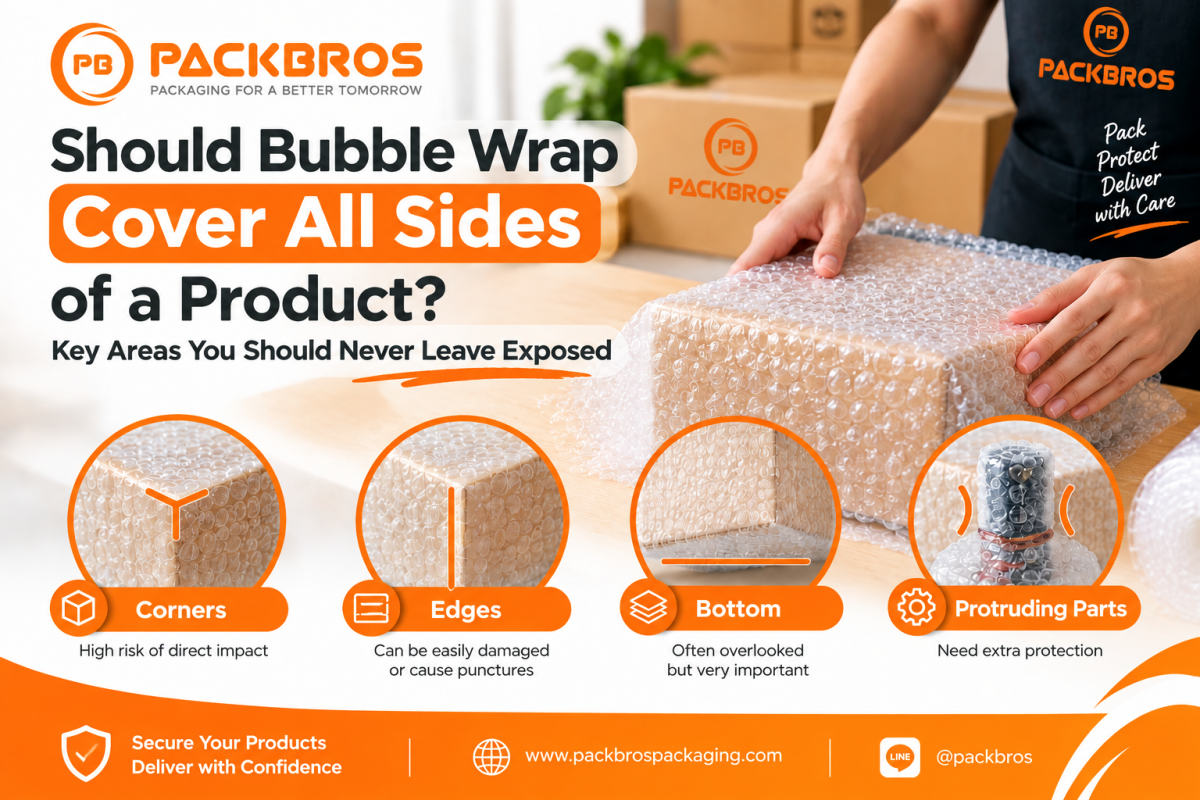
Should Bubble Wrap Cover All Sides of a Product? Areas You Should Never Leave Exposed
When packing a product with bubble wrap, many people focus mainly on how many layers they use. However, there is another important question:
Does the bubble wrap actually cover all the vulnerable areas of the product?
A product may be wrapped several times while still leaving corners, edges, or other parts exposed. During transportation, these uncovered areas may receive direct impact and become the first points to suffer damage.
Good protective packaging is therefore not only about using more bubble wrap. It is also about making sure that the areas most likely to receive impact are properly protected.
Should Bubble Wrap Cover Every Side of a Product?
For products that require cushioning during transportation, bubble wrap should generally provide protection around the areas that may come into contact with other objects or the inside of the shipping box.
This is particularly important for fragile products, items with hard corners, and products with surfaces that can easily be scratched or damaged.
However, this does not mean that every part of the product always needs exactly the same amount of cushioning.
Some areas may require additional protection depending on the product’s shape, weight, and fragility.
4 Areas to Check Before Packing
1. Product Corners
Corners are important areas to protect because they can receive concentrated impact if a package is dropped or hits another object.
This is particularly relevant for boxed products, picture frames, electronics, and other rectangular items.
After wrapping the product, check that every corner remains covered. Bubble wrap should not shift toward one side and leave another corner exposed.
2. Product Edges
Hard or sharp edges can create two problems.
First, the edge itself may be vulnerable to impact. Second, a sharp edge may press against or damage the bubble wrap from the inside.
For products with pronounced edges, adding additional cushioning specifically around these areas may be more efficient than adding unnecessary layers around the entire product.
3. The Bottom of the Product
The bottom is easy to overlook, particularly when packing bottles, jars, or products that are normally stored upright.
Wrapping only around the sides does not necessarily protect the bottom.
Before securing the bubble wrap with tape, turn the product over and check that the bottom has an adequate cushioning layer.
4. Protruding Parts
Pump heads, handles, buttons, connectors, caps, and other protruding components may be more vulnerable than the main body of a product.
These areas should not rely only on loosely wrapped bubble wrap around the main product.
Check that there is sufficient cushioning around each protruding part before placing the item into its shipping packaging.
Why Can Products Still Get Damaged Even When Fully Wrapped?
Bubble wrap is only one part of a protective packaging system.
Even when a product is completely covered, it may still be damaged if it is placed inside an oversized box with too much empty space.
The entire wrapped product can move inside the box and repeatedly hit the walls during transportation.
On the other hand, if the shipping box is too tight, the bubble wrap may become heavily compressed, reducing the cushioning space around the product.
Businesses should therefore consider:
Bubble wrap coverage + Empty space + Product movement + Box size
together rather than treating each factor separately.
You Don’t Always Need to Add More Bubble Wrap Around the Entire Product
Suppose a product is particularly vulnerable around its corners.
Adding two more complete layers around the entire item may increase material consumption without necessarily being the most cost-effective solution.
Instead, additional cushioning can sometimes be applied specifically to vulnerable areas while maintaining an appropriate number of layers around the rest of the product.
For businesses packing hundreds or thousands of orders, even a small reduction in unnecessary bubble wrap per package can make a meaningful difference in total packaging consumption.
Heavy Products Require Extra Attention to Exposed Areas
When a product is heavy, movement inside the package can create greater impact forces.
In addition to choosing an appropriate amount of cushioning, businesses should pay particular attention to corners, edges, and areas that support the weight of the product.
This makes proper bubble wrap coverage especially important for heavy products.
Online Sellers Can Create Packing Standards for Each SKU
Businesses that pack the same products repeatedly should not necessarily leave the amount of bubble wrap entirely to the judgment of each packing employee.
A simple packaging standard can be created, for example:
SKU A → Bubble wrap length → Number of layers → Reinforced areas → Box size
This helps keep packaging consistent across orders and makes packaging material costs easier to monitor.
It can also reduce differences between employees and make training new packing staff easier.
Choose the Right Bubble Wrap Width for Your Product
If bubble wrap needs to cover the entire product but the roll is too narrow, employees may need to overlap multiple sections of material.
This can increase packing time and create additional overlapping areas.
On the other hand, using a roll that is unnecessarily wide may result in excess material being used for every order.
Choosing the right bubble wrap width for the product can therefore improve both packing efficiency and material usage.
Bubble Wrap for Online Sellers, Wholesalers, Manufacturers and Businesses
PackBros is a manufacturer and supplier of bubble wrap and protective packaging materials in Thailand, serving online sellers, wholesalers, manufacturers, factories, and corporate customers.
Choosing the appropriate bubble wrap width and applying cushioning to all vulnerable areas can help businesses improve packaging consistency while reducing unnecessary material usage.
Frequently Asked Questions
Should bubble wrap completely cover a product?
For products that require impact protection, vulnerable areas should generally be covered with cushioning. Particular attention should be given to corners, edges, bottoms, and protruding components.
Is it okay if a small corner is exposed?
If the exposed corner is likely to receive impact during transportation, it is better to provide additional protection rather than leave it uncovered.
Do I need to add more layers around the entire product?
Not always. If only certain areas are vulnerable, additional cushioning can sometimes be added specifically to those areas instead of increasing the number of layers around the entire product.
Do I still need void fill if the product is wrapped in bubble wrap?
If the product can move significantly inside the shipping box, additional cushioning or void-fill material may still be necessary. Bubble wrap around the product does not automatically prevent the entire item from moving inside the box.
Conclusion
Effective bubble wrap packaging is not only about asking “How many layers should I use?”
Businesses should also ask “Which areas are actually protected?”
Corners, edges, bottoms, and protruding components are important areas to check before closing a package.
For businesses packing the same products repeatedly, establishing a standard for bubble wrap length, number of layers, reinforced areas, and box size can improve consistency while helping control packaging costs.