

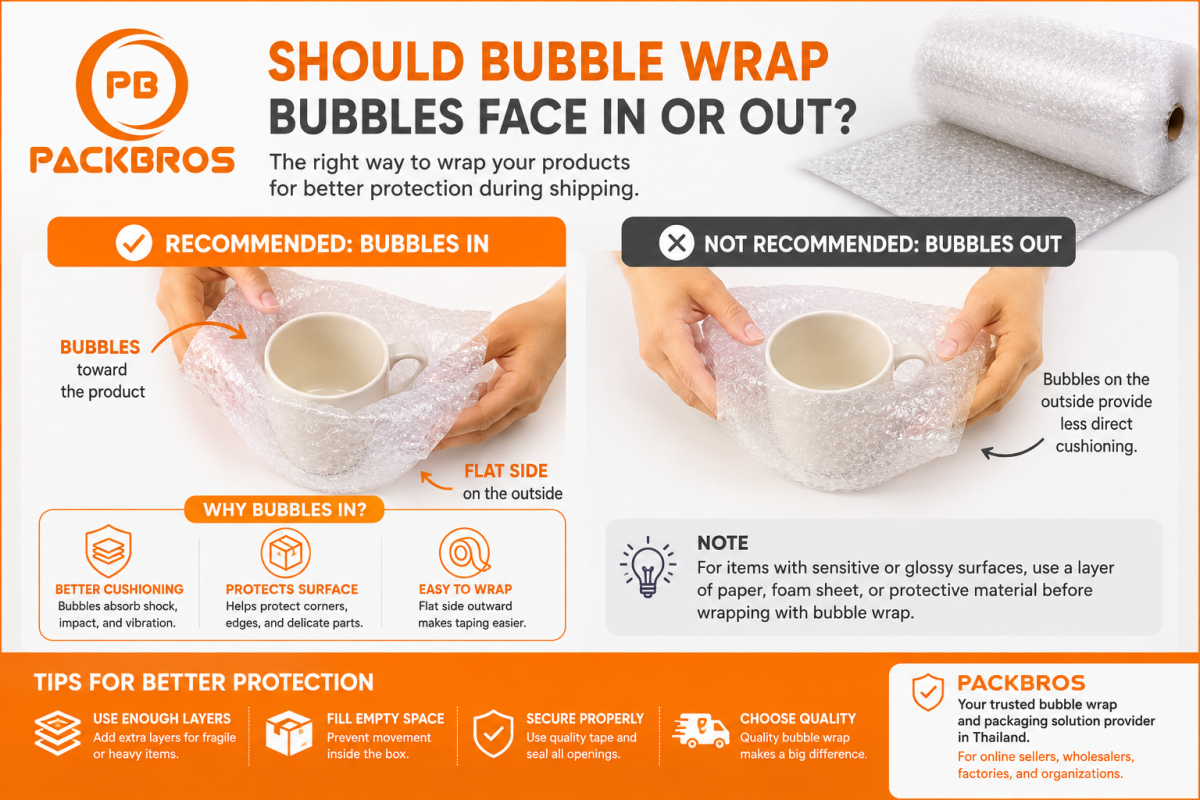
Should Bubble Wrap Bubbles Face In or Out?
Bubble wrap is one of the most widely used protective packaging materials for shipping products. However, a common question among online sellers, warehouses, and businesses is:
Should the bubbles face the product, or should they face outward?
For most packaging applications, the recommended method is simple:
Bubbles facing IN toward the product
Flat side facing OUT
This allows the air-filled bubbles to sit directly against the item and provide cushioning during handling and transportation.
Why Should the Bubbles Face the Product?
The air pockets in bubble wrap act as a cushioning layer between the product and external forces.
During transportation, packages may experience vibration, pressure, drops, or impacts. When the bubbles face inward, they are positioned directly around the product and can help absorb some of these forces before they reach the item.
This is particularly useful around vulnerable areas such as corners, edges, and protruding parts.
Another advantage is that keeping the flat side on the outside makes the package easier to handle and tape securely.
How to Wrap a Product with Bubble Wrap
For most products, follow these steps:
- Place the product on the bubble side of the bubble wrap.
- Make sure the bubbles are facing the product.
- Wrap the material completely around the item.
- Add additional layers around corners, edges, or fragile areas if necessary.
- Secure the bubble wrap using packing tape on the flat outer surface.
- Place the wrapped item inside the shipping box and make sure it cannot move excessively.
The objective is not simply to use as much bubble wrap as possible. Good packaging should protect the product while also preventing unnecessary movement inside the box.
How Many Layers of Bubble Wrap Should You Use?
There is no single number of layers that works for every product.
The appropriate amount depends on several factors, including:
- Product weight
- Fragility
- Shape and dimensions
- Sharp or protruding edges
- Shipping distance
- Handling conditions
Lightweight and relatively durable products may require only a few layers, while glassware, ceramics, electronics, and other fragile products may require additional cushioning.
For vulnerable products, extra protection should be concentrated around corners and edges rather than simply wrapping the entire product with excessive layers.
Can Bubble Wrap Be Used with the Bubbles Facing Out?
Yes, but it is generally not the preferred method for standard packaging.
For most products, placing the bubbles against the item provides direct cushioning.
However, some products have delicate surfaces that may require additional consideration. Glossy finishes, printed surfaces, polished products, or materials that can easily develop marks should not always be placed directly against bubble wrap.
In these situations, consider placing another protective material between the product and the bubble wrap, such as paper, foam sheet, or another suitable surface-protection material.
The product can then be wrapped with bubble wrap for additional impact protection.
Small Bubbles vs. Large Bubbles: Does It Matter?
Bubble size can affect how the material performs.
Small-bubble wrap is commonly used for general packaging because it can conform closely to the shape of the product.
Larger bubbles can provide greater cushioning depth for certain applications, particularly when more space is needed between the product and external impact.
The best option depends on the weight, fragility, shape, and transportation requirements of the product.
Is Bubble Wrap Enough Without Additional Packaging?
Not always.
Bubble wrap protects the surface and body of the product, but another common cause of shipping damage is movement inside the box.
Even a well-wrapped product can become damaged if it repeatedly moves and hits the inside walls of the shipping carton.
After placing the wrapped product inside the box, check the remaining empty space. If the item can move significantly, suitable void-fill or additional cushioning should be added.
Frequently Asked Questions
Which side of bubble wrap should face the product?
For most applications, the bubble side should face the product, while the flat side faces outward.
Why should bubble wrap bubbles face inward?
The bubbles create a cushioning layer directly around the product, helping reduce the effects of impact, pressure, and vibration during transportation.
Can the flat side face the product?
It can, but this is generally not the recommended method for standard packaging. For most products, placing the bubbles toward the item provides better direct cushioning.
Can bubble wrap leave marks on delicate surfaces?
Certain sensitive, glossy, painted, or printed surfaces may be affected by direct contact. If this is a concern, use an appropriate protective layer between the product and the bubble wrap.
Does using more bubble wrap always provide better protection?
Not necessarily. Effective packaging also depends on the product’s weight, vulnerable areas, the amount of movement inside the box, and the overall packaging design.
Conclusion
For most products, the recommended bubble wrap orientation is:
Bubble side → Facing the product
Flat side → Facing outward
This arrangement allows the bubbles to cushion the product directly while leaving a smooth exterior that is easier to tape and handle.
For products with delicate surfaces, consider adding a protective layer before applying bubble wrap to reduce the risk of surface marks.
PackBros is a bubble wrap and protective packaging manufacturer in Thailand, supplying packaging solutions for online sellers, wholesalers, factories, organizations, and businesses looking for reliable packaging materials for domestic use and export.