
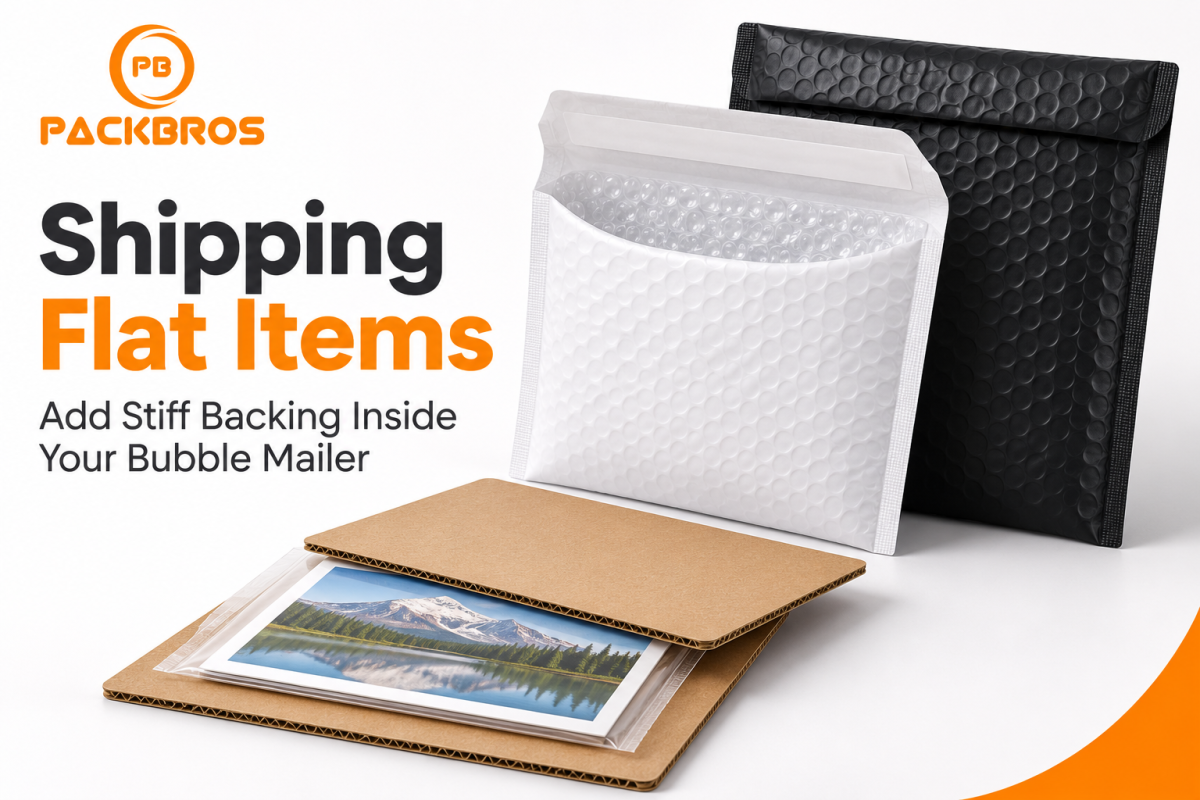
Flat items such as postcards, cards, thin notebooks and prints may need stiff backing or rigid packaging inside a bubble mailer to help resist bending.
Bubble cushioning and bending resistance serve different purposes. A padded envelope remains flexible, so it should not be treated as a rigid shipping container.
If the item must arrive flat with clean corners and no creases, assess its support before choosing the mailer size.
Why Can a Padded Item Still Bend?
Bubble lining does not turn an envelope into a rigid box. Pressure across the middle of a flexible pack can still bend the contents.
Before packing, ask:
- Does the item need cushioning or surface protection?
- Must it remain flat throughout handling?
If maintaining its shape depends on rigid support, consider a suitable rigid mailer or carton rather than relying on bubble padding alone.
Support the Whole Item
Backing that is smaller than the product can leave corners and edges exposed.
Choose support that covers the item adequately, and check that the contents cannot slide beyond it once packed.
For printed or easily marked surfaces, use a clean, compatible sleeve or protective layer before adding the backing.
| Flat item | Points to check |
|---|---|
| Cards and postcards | Surface protection and support around all corners |
| Thin notebooks | Cover stiffness, spine condition and internal movement |
| Prints and artwork | Surface compatibility, flatness and support material |
| Valuable or crease-sensitive items | More rigid packaging and application-specific assessment |
There is no single backing thickness suitable for every item. Size, stiffness and shipping conditions all affect the choice.
Prevent the Contents from Sliding
Placing an item between two boards is not enough if it can slide out from between them.
Keep the item centred and secure the protective assembly appropriately. Apply tape to the sleeve or backing rather than directly to the product.
Avoid tightening tape until the boards bow or press into the item’s edges. Plan an opening method that does not require the recipient to use a blade close to the contents.
Choose the Mailer After Adding the Backing
Measure the complete pack, including the product, sleeve and supporting boards.
Check that:
- The assembly slides in and out without force.
- Board corners do not catch on the seams.
- The flap closes flat without stretching the envelope.
- There is no excessive room for movement.
A mailer selected from the product’s bare dimensions may be too small once the support materials are added.
Does a White or Black Bubble Mailer Resist Bending Better?
Colour does not establish bending resistance. Assess the mailer’s construction and the support inside it.
White and black mailers can be chosen for presentation and practical preferences, but neither colour should be treated as proof of greater structural protection.
When selecting bubble mailers from PackBros, provide the dimensions of the fully prepared pack and explain any backing boards or inner packaging being used.
When Should You Use a Carton Instead?
Consider a more rigid packaging system when:
- The supported pack still bends easily during normal handling.
- The item is too large for the backing to support effectively.
- Any crease would make the product unacceptable.
- Other hard items in the order could press against the flat item.
- Previous shipments have suffered bending damage despite added support.
A “Do Not Bend” label can communicate handling preferences, but it should not replace physical protection.
Trial the Pack Before Using It for Every Order
Start with a representative item, including the largest or most vulnerable version in the range.
Check insertion, closure and unpacking. Record the backing arrangement, mailer size and product position so the packing team can repeat the method consistently.
If you trial a shipment, ask the recipient to inspect the product’s corners, surfaces and inner packaging—not just whether the envelope arrived intact.
A successful trial is useful evidence for that setup, but it does not guarantee the same outcome on every route.
Frequently Asked Questions
Can I send postcards in a bubble mailer?
Yes, with an appropriate packing arrangement. If they must remain flat, use suitable surface protection and stiff support rather than relying on the envelope alone.
Can more bubble wrap replace a backing board?
Do not treat them as interchangeable. Bubble wrap remains flexible and does not provide the same structural support as stiff backing.
Does stacking several flat items make backing unnecessary?
Not necessarily. The stack may still bend, slide or rub internally. Assess the complete set and provide appropriate support.
Will backing boards require a larger mailer?
They may. Measure and trial the finished assembly, including its total thickness, before choosing the envelope.
Check corner support, internal movement and pack stiffness first. Then choose a mailer that fits comfortably and closes correctly.