

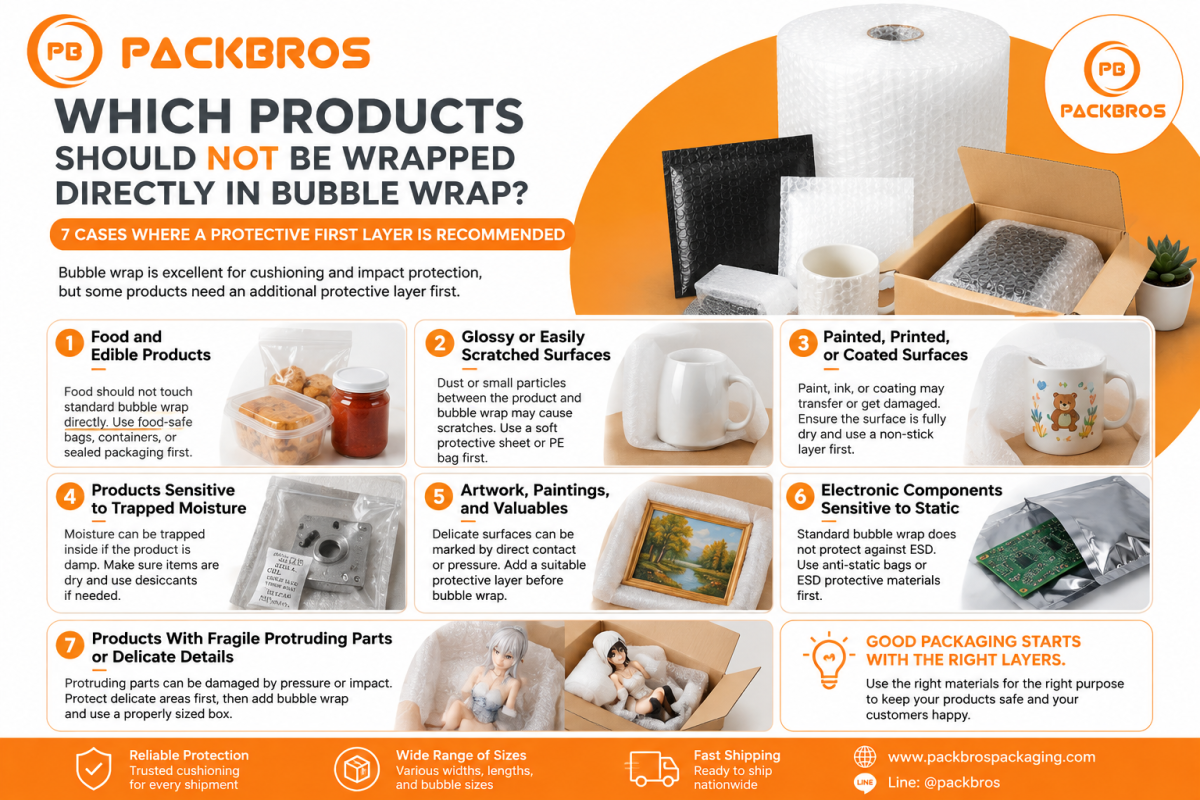
Which Products Should Not Be Wrapped Directly in Bubble Wrap? 7 Cases Where a Protective First Layer Is Recommended
Bubble wrap is one of the most widely used protective packaging materials for e-commerce businesses, warehouses, factories, and shipping operations. It helps absorb impact, reduce vibration, and protect products from damage during transportation.
However, not every product should come into direct contact with standard bubble wrap.
Some products require an additional protective layer between the product and the bubble wrap. This first layer may protect the product from scratches, moisture, static electricity, surface marks, or direct contact.
Here are seven situations where using an appropriate first layer before bubble wrapping is recommended.
1. Food and Edible Products
Food, baked goods, snacks, fresh food, and other edible products should generally not come into direct contact with standard packaging bubble wrap.
Bubble wrap designed for general packaging and shipping is primarily intended to provide cushioning and impact protection. This does not automatically mean that the material is suitable for direct food contact unless the particular product has been manufactured and certified for that purpose.
Recommended packaging method:
Place food inside suitable food-contact packaging, such as a food-grade bag, container, bottle, or sealed package first. Bubble wrap can then be used around the outer packaging to provide additional protection during transportation.
For example, sealed sauce bottles, beverage bottles, food jars, and packaged food products can be bubble wrapped on the outside to reduce the risk of damage.
2. Glossy or Easily Scratched Surfaces
Acrylic products, glossy plastic items, decorative pieces, and products with delicate surfaces may require an additional protective layer.
Bubble wrap itself is relatively soft. However, dust or small particles trapped between the product and the bubble wrap may rub against the surface as the package moves during transportation.
Recommended packaging method:
Cover the product with a soft protective sheet, suitable paper, or PE bag before applying bubble wrap around the outside.
3. Painted, Printed, or Coated Surfaces
Printed products, painted items, coated surfaces, handmade products, and newly finished components require extra care.
If paint, ink, or a coating has not fully cured, direct contact and prolonged pressure from packaging materials may leave marks or affect the surface.
Recommended packaging method:
Make sure the surface is completely dry and cured. Use a suitable non-stick protective material as the first layer before adding bubble wrap for cushioning.
4. Products Sensitive to Trapped Moisture
Bubble wrap is commonly made from PE plastic and does not absorb moisture like paper.
However, if a product is already damp when tightly wrapped, moisture can become trapped inside the packaging.
This may be a concern for certain metal components, tools, machinery parts, or other moisture-sensitive products.
Recommended packaging method:
Make sure the product is dry before packing. Depending on the product and shipping conditions, moisture-control materials such as desiccants may also be appropriate.
5. Artwork, Paintings, and Valuable Collectibles
Paintings, prints, collectibles, and other valuable items can have extremely delicate surfaces.
Placing the bubble side directly against a sensitive surface for an extended period may not be suitable, particularly when the item has a delicate coating, paint layer, or surface that can develop pressure marks.
Recommended packaging method:
Apply an appropriate surface-protection material first. Bubble wrap can then be added as an outer cushioning layer to help protect against impact during handling and transportation.
6. Electronic Components Sensitive to Static Electricity
Circuit boards, electronic components, and certain electronic devices may require protection against electrostatic discharge (ESD).
Standard PE bubble wrap should not automatically be considered an ESD-protective material.
Recommended packaging method:
For products requiring ESD protection, use an appropriate anti-static or ESD-protective bag or material first. Standard bubble wrap can then be used outside that layer to provide cushioning and impact protection.
7. Products With Fragile Protruding Parts or Delicate Details
Models, figurines, decorative products, handicrafts, and products with small protruding components can be vulnerable to pressure.
Adding more layers of bubble wrap does not necessarily solve this problem. Bubble wrap primarily provides cushioning; it is not a rigid structural material designed to protect every fragile component from crushing forces.
Recommended packaging method:
Protect delicate or protruding sections individually first. Add bubble wrap around the product and use a properly sized outer box that prevents excessive movement without compressing fragile components.
Which Products Can Be Wrapped Directly in Bubble Wrap?
Many ordinary products can be wrapped directly in bubble wrap, particularly when their surfaces are durable, they have no special contact restrictions, and they do not require specialized protection.
The important point is to understand that different packaging materials perform different functions.
Bubble wrap primarily provides cushioning and impact protection, while the first protective layer may serve another purpose, such as preventing scratches, controlling moisture, providing ESD protection, or preventing direct contact with the product.
Using an additional layer does not mean that bubble wrap is ineffective. It simply means that each packaging material should be used for the purpose it is designed to perform.
For businesses shipping products regularly, choosing the correct combination of packaging materials can help reduce product damage, returns, and unnecessary packaging costs.
Frequently Asked Questions
Can bubble wrap directly touch a product?
Yes, many general products can be wrapped directly in bubble wrap. However, products with sensitive surfaces, food products, ESD-sensitive electronics, artwork, or products with special packaging requirements may need a suitable protective layer first.
Can standard bubble wrap be used to wrap food?
Standard packaging bubble wrap should not be used in direct contact with food unless the specific material is suitable and certified for food-contact use. Food should first be placed in appropriate food packaging, with bubble wrap used around the outside for cushioning.
Can I bubble wrap bottles containing food or beverages?
Yes. When food or beverages are securely sealed inside bottles, jars, or other suitable containers, bubble wrap can be used around the exterior packaging to help protect against impact.
Can standard bubble wrap be used for electronics?
It can provide cushioning, but electronics that require protection against electrostatic discharge should first be placed in appropriate ESD-protective packaging.
Does every product need a protective layer before bubble wrapping?
No. Many everyday products can be wrapped directly in bubble wrap. The need for a first layer depends on the product’s surface, sensitivity, material, and packaging requirements.
PackBros is a bubble wrap and protective packaging manufacturer in Thailand, supplying packaging solutions for e-commerce sellers, wholesalers, factories, organizations, and businesses requiring reliable protective packaging for domestic and export shipments.