
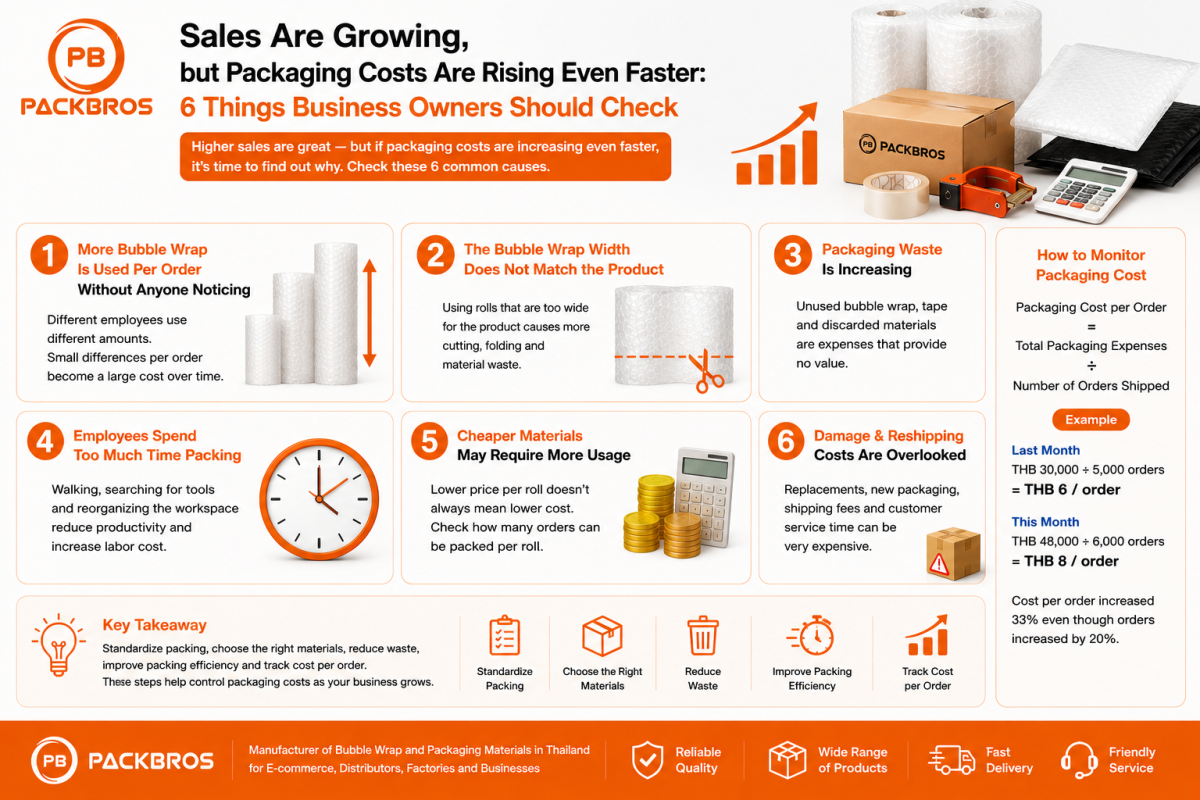
Sales Are Growing, but Packaging Costs Are Rising Even Faster: 6 Things Business Owners Should Check
Growing sales are usually a good sign. However, many businesses begin to notice an unexpected problem as their order volume increases: sales are growing, but packaging costs are increasing even faster.
When order volume is low, an extra THB 1–2 in packaging cost per order may seem insignificant. But when a business ships hundreds of orders per day, that small difference can quickly turn into thousands or even tens of thousands of baht in additional monthly expenses.
The problem is not always simply that “packaging materials are getting more expensive.”
The entire packing process should be examined — from the amount of bubble wrap used and the sizes of packaging materials to packing time, material waste, and product damage during delivery.
Here are 6 areas business owners should check when packaging costs start rising faster than sales.
1. More Bubble Wrap Is Being Used Per Order Without Anyone Noticing
When a business has only a small number of orders, the owner may pack the products personally and know exactly how much bubble wrap should be used.
As order volume grows and more employees become involved in packing, material usage can become inconsistent if there is no clear packing standard.
For the same product, one employee may use 50 cm of bubble wrap while another uses 80 cm or wraps the product several extra times simply to feel more confident that it will arrive safely.
The difference may look small for one package.
But multiplied by thousands of orders every month, unnecessary material usage can become a significant expense.
What to check: Select the same SKU and compare several packages prepared by different employees.
If the amount of bubble wrap used varies significantly, consider creating a standard packing procedure for your main products.
2. The Bubble Wrap Width Does Not Match the Product
Some businesses use one bubble wrap width for every product because it makes inventory management easier.
However, if the business sells products in many different sizes, using a roll that is much wider than necessary can create additional folding, cutting, and material waste.
For example, if a large proportion of your orders contain small products but employees always use a very wide bubble wrap roll, more material may be consumed than necessary.
Therefore, businesses should not only ask:
“How much does one roll cost?”
They should also consider whether the width being used is appropriate for the products being packed most frequently.
3. Bubble Wrap, Tape and Packaging Waste Are Increasing
Take a look at the waste bins around your packing area at the end of the day.
Do you see large pieces of unused bubble wrap?
Are employees frequently cutting pieces too large and throwing away the excess?
Is tape being pulled out and discarded because the length was incorrect?
Every piece of discarded material represents packaging that the company has already paid for but never used to ship a customer order.
As order volume grows, even a small amount of waste per package can become substantial.
Businesses handling large order volumes should therefore monitor their packaging waste rate, not just the purchase price of packaging materials.
4. Employees Are Spending Too Much Time Packing Each Order
Packaging cost is not limited to bubble wrap, mailers and tape.
Employee time is also a cost.
If employees have to walk across the room to get bubble wrap, search for scissors, pick up tape or repeatedly move products between work areas, the business may eventually need additional employees sooner than necessary.
Try measuring the time from when an employee receives an order until the package is completely ready for shipment.
Then observe where that time is actually being spent.
Is the employee packing the product?
Or are they walking, searching for materials, cutting supplies and reorganizing the workspace?
A well-designed packing station can increase packing capacity even without changing the packaging materials themselves.
5. Cheaper Packaging Materials May Require More Material Per Order
A lower price per roll or pack does not automatically mean a lower packaging cost per order.
If a cheaper material requires employees to use significantly more of it to provide the same level of protection, the actual cost per package may increase.
Instead of comparing only:
“How much does this roll cost?”
consider asking:
“How many orders can we pack with one roll?”
This provides a much more useful measurement of the actual cost of packaging.
6. Product Damage and Reshipping Costs Are Not Being Included
One of the most commonly overlooked packaging expenses is the cost of damaged shipments.
When a product arrives damaged, the business may have to absorb several costs at the same time, including:
- Replacement product
- New packaging materials
- Additional shipping charges
- Employee time to repack the order
- Customer service time required to resolve the problem
For this reason, reducing packaging materials too aggressively just to save a small amount per order may actually increase total costs if product damage rates rise.
The objective should not be to use the least packaging possible.
It should be to use the appropriate amount of packaging necessary to protect the product effectively.
How Can You Tell If Your Packaging Cost Is Increasing Too Quickly?
A simple metric can help:
Packaging Cost per Order = Total Packaging Expenses ÷ Number of Orders Shipped
For example:
Previous month
THB 30,000 packaging expenses ÷ 5,000 orders
= THB 6 per order
Current month
THB 48,000 packaging expenses ÷ 6,000 orders
= THB 8 per order
Order volume increased by 20%, but packaging cost per order increased from THB 6 to THB 8 — an increase of approximately 33%.
This is a signal to investigate whether the increase is coming from material prices, excessive usage, waste, labor, or the packing process itself.
Conclusion
Packaging expenses naturally increase as sales and order volume grow.
What businesses should watch carefully is whether packaging cost per order is also continuously increasing.
Standardizing packing procedures, selecting appropriate material sizes, reducing waste, improving packing station layouts, and monitoring cost per order can help a business process more orders without allowing packaging expenses to grow faster than revenue.
PackBros is a manufacturer of bubble wrap and packaging materials in Thailand, supplying online sellers, wholesalers, factories and organizations that require packaging materials for regular business operations.
Choosing packaging materials that match the product and the packing process can help businesses improve efficiency while keeping packaging costs under control.
FAQ
Should packaging expenses be calculated per order?
Yes. Monthly order volumes can vary significantly, so looking only at total packaging expenses may be misleading. Cost per order makes it easier to compare packaging efficiency from month to month.
Should a business use one bubble wrap width or several widths?
It depends on the range of products and order volume. If products vary significantly in size, using more than one bubble wrap width may reduce unnecessary cutting and material waste.
Can using less bubble wrap reduce packaging costs?
Yes, but only when the amount is still sufficient to protect the product. If using less material increases product damage, the cost of replacements and reshipping may exceed the savings.
How often should packaging costs be reviewed?
Businesses with regular or high order volumes should review packaging costs at least monthly and compare total expenses, cost per order and order volume.
Where should a business start when trying to reduce packaging costs?
Start by observing the actual packing process. Measure material usage for common SKUs, inspect packaging waste, and measure packing time per order. These observations can reveal cost leaks that are difficult to identify from purchase prices alone.