
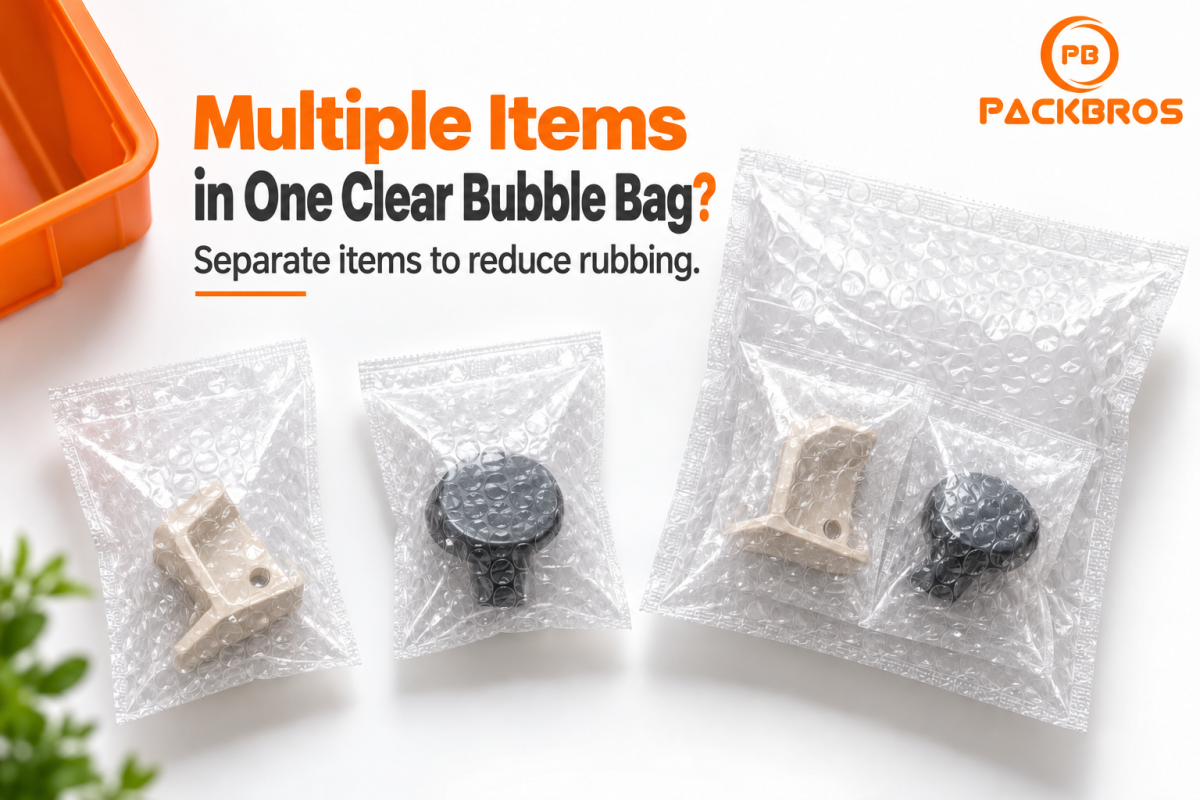
Can You Put Multiple Items in One Clear Bubble Bag?
Multiple items can share a clear bubble bag in some applications, but first check whether they can scratch, strike or press against one another. The cushioning around the bag does not separate the items inside it.
For fragile products, delicate finishes or components with hard edges, protect each item appropriately before grouping them into a kit.
Why Can Items Still Get Scratched Inside a Bubble Bag?
Two products placed in the same compartment may touch directly.
During handling, a harder component can rub against another surface, while a protruding part can press into the item beside it.
Assess two different protection needs:
- External protection: cushioning and the outer shipping container.
- Protection between items: separate wrapping, individual bags or suitable dividers.
A shared bag can keep a kit together, but it does not necessarily provide both types of protection.
Which Products Might Be Suitable for Packing Together?
Possible candidates include soft items without sharp features or products that already have suitable individual protective packaging.
Test the actual arrangement, including total weight and movement inside the bag.
| Product Characteristics | What to Consider |
|---|---|
| Soft items without rigid protrusions | Check movement and condition after handling |
| Glossy or easily marked surfaces | Use suitable material to separate surfaces |
| Hard components with sharp edges | Protect exposed features and separate items |
| Fragile glass or ceramic products | Protect individually and use a suitable outer container |
| Small parts that could escape through the opening | Use an appropriate securely closed inner container |
For an overview of packaging options, see how bubble wrap rolls and bubble mailers differ. The final method should reflect the risks of the actual products.
Can You Bag Items Separately and Then Group Them?
Yes. This can be practical when each component needs protection but the complete kit must remain together.
For example, a kit may contain one main product and two accessories. Protect each piece as required, then place the complete set in suitable grouping packaging with a kit reference and quantity.
Define the role of each layer:
Individual packaging protects the components; grouping packaging keeps the set together.
This makes it easier to check whether the packing method is complete before dispatch.
Should You Measure the Products Before or After Wrapping?
Measure the arrangement that will actually go into the bag.
Individual wrapping or inner containers can increase the overall dimensions. The bag also needs enough clearance for insertion and closure.
Before discussing a bag size, prepare:
- Dimensions and quantity of each component.
- Individual protection requirements.
- Overall dimensions of the assembled kit.
- Total weight.
- Required closure method.
- Whether the bag is for internal handling or customer shipping.
The principles in choosing a suitable bubble bag or mailer size help explain why the unwrapped product dimensions alone may be insufficient.
What Should You Check in a Packing Trial?
Check fit, closure and the position of the contents. Gently lift and change the package’s orientation to see whether items slide into one another.
Look for:
- Hard edges pressing against the bag.
- Excessive tension on the material.
- Components stacking or shifting.
- Contact between sensitive surfaces.
This is an initial inspection rather than proof that the packaging will withstand every shipping condition.
For regular shipments, evaluate the package under representative handling or suitable packaging tests and inspect the contents at the destination.
Can Using Fewer Bags Reduce Costs?
It may reduce material use, but the complete cost also includes preparation, inspection, rework and damage.
Compare the actual packing process rather than assuming fewer bags always mean lower total cost. This connects with the approach in evaluating packing time and costs with clear bubble bags.
For a clear-bag kit application, provide PackBros with the component list, quantities, dimensions and intended protection method. Ask about suitable bag options, closure requirements and the production schedule for your application.
Frequently Asked Questions
Can one large clear bubble bag replace several smaller bags?
Sometimes, if the items do not damage one another and testing supports the arrangement. Where individual protection is needed, the larger bag mainly serves to group the kit.
Is the package acceptable if the items touch but do not break?
Check for other damage, including scratches, coating marks and bent components. An unbroken item may still be unsuitable for delivery to a customer.
Can a clear bubble bag be used as the outer shipping package?
That depends on the product, bag construction and carrier requirements. A bag intended for inner cushioning may still need an appropriate outer shipping container.
Conclusion
Before grouping several items in one clear bubble bag, assess contact and movement between them. Protect components individually where needed, then size the grouping bag around the complete packing arrangement.