
How to Use Bubble Wrap Correctly: Should the Bubbles Face In or Out?
Bubble wrap is one of the most commonly used protective packaging materials for online stores, warehouses, manufacturers, and businesses that regularly ship products.
However, there is one simple question that many people still ask:
Should the bubbles face the product or face outward?
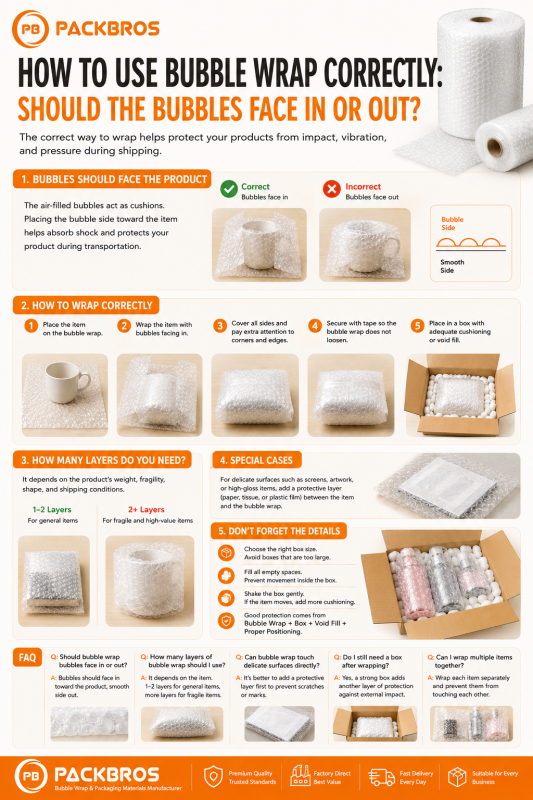
In most cases, the correct way is to place the bubble side facing inward toward the product, while the smooth side faces outward.
This allows the air-filled bubbles to sit directly around the item and provide a cushioning layer against impacts, pressure, and vibration during transportation.
There are, however, some exceptions—especially when packing products with delicate surfaces.
Why Should the Bubbles Face the Product?
The small air pockets in bubble wrap work like hundreds of tiny cushions surrounding the product.
When a package experiences an impact, vibration, or pressure during transportation, these air pockets help absorb and distribute some of the force before it reaches the item.
Placing the bubble side toward the product keeps this cushioning layer close to the surface that needs protection.
The smooth side on the outside also makes the package easier to handle and secure with packing tape.
How to Wrap a Product with Bubble Wrap Correctly
Start by choosing bubble wrap that is suitable for the size, weight, and fragility of the product.
Place the item on the bubble wrap with the bubbles facing toward the product.
Wrap the material completely around the item, making sure all sides are covered.
Pay extra attention to vulnerable areas such as:
- Corners
- Edges
- Bottle bases
- Bottle caps
- Handles
- Protruding parts
Once the product is fully covered, secure the bubble wrap with tape so that it does not loosen during transportation.
Avoid wrapping the product excessively tight. Compressing the bubbles before shipping reduces the amount of air available to provide cushioning.
How Many Layers of Bubble Wrap Should You Use?
There is no single number of layers that works for every product.
The amount of bubble wrap required depends on the item’s weight, shape, fragility, value, and shipping conditions.
For lightweight and less fragile products, one or two layers may provide sufficient basic protection.
Fragile products such as glassware, ceramics, bottles, and delicate components generally require additional cushioning.
Extra protection should also be added around corners, edges, and other areas that are more likely to receive an impact.
A useful rule is that after wrapping, the product should not be able to receive a direct impact easily through the protective layer.
Is Bubble Wrap Alone Enough for Fragile Items?
Not always.
Bubble wrap is only one part of an effective packaging system.
For fragile products, the wrapped item should normally be placed inside an appropriately sized shipping box.
Any empty space inside the box should also be filled with suitable cushioning or void-fill material.
This prevents the product from moving around during transportation.
After packing, gently shake the box.
If you can still feel or hear the product moving inside, additional void fill may be required.
When several fragile products are shipped together, it is also better to wrap each item individually rather than allowing the products to touch each other directly.
Should the Smooth Side Ever Face the Product?
There are situations where bubble wrap should not be placed directly against a product’s surface.
Examples may include:
- High-gloss surfaces
- Screens
- Artwork
- Coated surfaces
- Products with delicate finishes
- Items that may develop marks from prolonged contact
For these products, consider placing a clean protective layer such as paper, tissue, plastic film, or another suitable surface-protection material around the item first.
Bubble wrap can then be applied outside that protective layer.
Therefore, although “bubbles facing inward” is a useful general rule, the characteristics of the product should always be considered.
Why Can Products Still Break Even When Wrapped in Bubble Wrap?
Using bubble wrap does not automatically guarantee that a product will survive shipping without damage.
Damage can still occur when:
- Too little bubble wrap is used
- Vulnerable corners are not protected
- The shipping box is too large
- There is excessive empty space inside the box
- Multiple fragile items can collide with each other
- The product can move freely inside the package
- The outer shipping box is not suitable for the weight of the product
Good protective packaging therefore involves more than simply adding additional layers of bubble wrap.
For better protection, consider the complete packaging system:
Bubble Wrap + Shipping Box + Void Fill + Proper Product Positioning
These elements work together to reduce movement and protect the product during transportation.
FAQ: Bubble Wrap Packaging
Should bubble wrap bubbles face in or out?
For most products, the bubbles should face inward toward the item, while the smooth side faces outward.
Which side of bubble wrap should be on the outside?
Generally, the smooth side should face outward. This also makes the wrapped product easier to secure with tape.
How many layers of bubble wrap should I use?
It depends on the product. Lightweight, non-fragile products may only require one or two layers, while fragile or heavier items may require additional cushioning.
Can bubble wrap touch a screen directly?
For screens and other delicate surfaces, consider placing a clean, smooth protective material over the surface before applying bubble wrap.
Do I still need a shipping box after wrapping an item in bubble wrap?
For parcel shipping—especially for fragile products—an appropriate outer box is recommended. Bubble wrap provides cushioning, while the box provides structural protection against external forces.
Conclusion
The easiest rule to remember is:
“Bubbles toward the product — smooth side outward.”
For most everyday products, this positioning allows the air-filled bubbles to provide cushioning close to the item being protected.
However, proper packaging involves more than choosing which side of the bubble wrap faces inward.
The amount of cushioning, protection of corners and edges, box size, void fill, and preventing movement inside the package all play an important role in reducing shipping damage.
PackBros is a manufacturer of bubble wrap and packaging materials in Thailand, supplying packaging solutions for online sellers, wholesalers, factories, and organizations that regularly require protective packaging materials.