

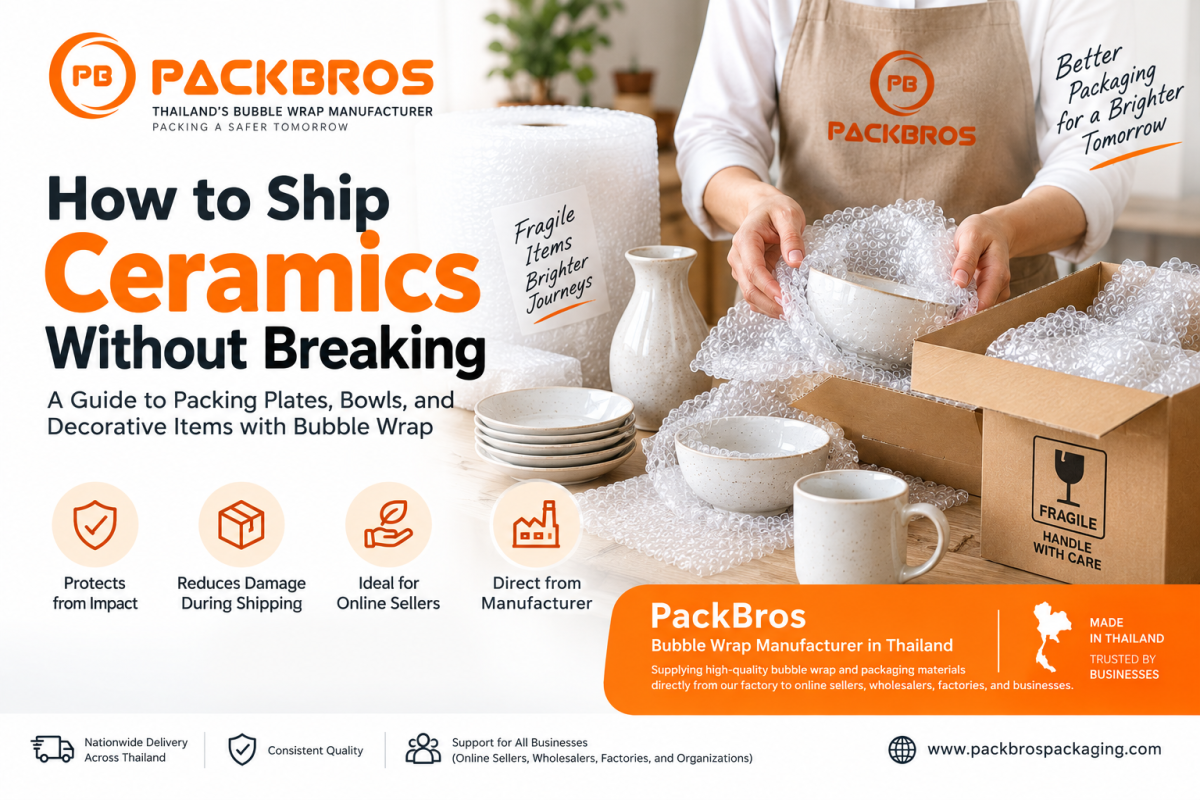
How to Ship Ceramics Without Breaking: A Guide to Packing Plates, Bowls, and Decorative Items with Bubble Wrap
Ceramic products such as plates, bowls, cups, vases, plant pots, and decorative items require extra care during shipping. Even when the outer box appears undamaged, vibration, impact, or movement inside the package can still cause chips, cracks, or breakage.
For online sellers, ceramic manufacturers, home décor businesses, and companies that regularly ship fragile products, choosing the right bubble wrap and using proper packing techniques can help reduce the risk of damage during transportation.
PackBros is a bubble wrap manufacturer and packaging material supplier in Thailand, producing bubble wrap directly from our factory for online sellers, wholesalers, factories, businesses, and organizations.
In this guide, we explain how to pack ceramic plates, bowls, vases, and other fragile ceramic products more effectively for shipping.
Why Do Ceramic Products Break Easily During Shipping?
Ceramics are hard but relatively brittle. They can crack or break when subjected to concentrated impact, particularly around thinner or protruding areas such as:
- Plate edges
- Rims of bowls and cups
- Cup handles
- Vase openings
- Corners or decorative projections
- Product bases
Damage does not always come from an external impact.
When several ceramic products are packed together without sufficient cushioning between them, they can move and hit one another while in transit.
Effective ceramic packaging should therefore help protect against both external impact and movement inside the shipping box.
How to Wrap Plates, Bowls, and Ceramic Products with Bubble Wrap
1. Wrap Each Item Individually
When shipping several plates, bowls, or cups together, avoid stacking everything first and wrapping bubble wrap only around the outside of the entire stack.
Each item should be individually protected to prevent ceramic surfaces from directly contacting and hitting one another.
When plates or bowls need to be stacked, place cushioning material between each piece before grouping them together.
2. Add Extra Protection Around Edges and Corners
Plate edges, bowl rims, handles, and protruding parts are particularly vulnerable to impact.
Before wrapping the entire product, additional bubble wrap can be placed around these high-risk areas. The whole item can then be wrapped again for overall protection.
The objective is to reduce the amount of external impact that can be transferred directly to the most fragile parts of the product.
3. Cover the Entire Product with Bubble Wrap
Bubble wrap should cover the product on all sides. Avoid leaving exposed edges, corners, or other fragile areas.
After wrapping, secure the bubble wrap with packing tape so that it does not loosen during handling and transportation.
4. Add More Bubble Wrap According to the Product’s Fragility
There is no single correct number of bubble wrap layers for every ceramic product.
The appropriate amount depends on several factors, including the product’s weight, size, shape, and fragility.
For example, a large and heavy ceramic vase requires different protection from a small ceramic cup.
Instead of focusing only on “How many layers should I use?”, also consider whether vulnerable areas are sufficiently protected and whether the product can still move after packing.
Packing Multiple Plates: Don’t Stack Them Without Cushioning
A common packing mistake is stacking several ceramic plates together and wrapping bubble wrap only around the outside of the stack.
Even if the outside is covered with multiple layers, individual plates may still hit each other when the parcel vibrates during transportation.
A better arrangement is:
Plate → Cushioning Material → Plate → Cushioning Material
Repeat this between each piece before adding additional protection around the entire group as necessary.
This helps reduce direct ceramic-to-ceramic contact.
Why Can Ceramics Still Break Even with Multiple Layers of Bubble Wrap?
Many people assume that using enough bubble wrap automatically prevents breakage.
However, another important factor is empty space inside the shipping box.
If the box is significantly larger than the wrapped product, the item may still move around inside it.
When the parcel is lifted, stacked, placed down, or subjected to impact, the product can move toward the side of the box, allowing impact forces to reach the item despite the bubble wrap.
After placing the product inside the box, fill excessive empty space with suitable cushioning material.
Before sealing the carton, gently move the box. If you can feel the product shifting significantly, additional cushioning may be needed.
Vases and Irregularly Shaped Ceramics Need Extra Attention
Some ceramic products have irregular shapes, such as vases, ceramic figurines, decorative objects, and handmade products.
These products may have thin sections or protruding parts that are more vulnerable than the rest of the item.
Start by adding extra protection to fragile areas such as the opening, base, handles, limbs, corners, or decorative projections. Then wrap the entire product with bubble wrap.
Protecting specific vulnerable areas can be more effective than simply adding the same number of layers over every part of the product without considering its shape.
How to Choose Bubble Wrap for Packing Ceramics
In addition to packing technique, the quality and dimensions of bubble wrap can affect both product protection and packing efficiency.
Businesses should consider factors such as bubble condition, material thickness, roll length, weight, and roll width.
For companies packing products every day, selecting a bubble wrap width that closely matches the product size can also make packing easier, reduce unnecessary cutting, and help control the amount of material used per order.
PackBros manufactures and supplies bubble wrap in multiple widths, suitable for different applications ranging from online retail packaging to regular use by factories and organizations.
When Buying Bubble Wrap from a Factory, Should You Compare Only the Price per Roll?
No. The price per roll alone does not necessarily tell you which bubble wrap offers the lowest actual packaging cost.
Bubble wrap rolls advertised with similar dimensions can differ in thickness, weight, material quantity, and actual roll length.
For businesses that consume bubble wrap regularly, it is more useful to consider the cost per meter and the number of products that can actually be packed from each roll, together with the purchase price.
A cheaper roll may not necessarily result in lower packaging costs if it contains less material, has a shorter actual length, or requires more material to protect each product.
PackBros: Bubble Wrap Manufacturer for Online Sellers, Factories, and Businesses in Thailand
PackBros is a bubble wrap manufacturer and packaging material supplier in Thailand. We manufacture and distribute bubble wrap directly from our factory for online sellers, wholesalers, industrial factories, businesses, and organizations.
For companies shipping ceramics, glassware, decorative items, or other fragile products, choosing the appropriate bubble wrap width and packing method can help reduce product damage while improving control over packaging material costs.
PackBros offers bubble wrap in multiple widths to support different product sizes and packing requirements, from general-purpose packaging to regular high-volume business use.
Conclusion
Packing ceramics safely is not simply about using as much bubble wrap as possible.
The important steps are to protect each item individually, reinforce vulnerable edges and protruding areas, prevent ceramic products from hitting each other, and minimize movement inside the shipping box.
For online sellers, factories, and businesses that ship products regularly, selecting bubble wrap that matches the size and characteristics of the products — while considering the cost per meter and per packed order — can improve both product protection and packaging efficiency.
Frequently Asked Questions (FAQ)
How many layers of bubble wrap should I use for ceramic plates?
There is no fixed number suitable for every product. The amount of protection should depend on the item’s weight, size, shape, and fragility. Edges and other vulnerable areas may require additional protection.
Can several ceramic plates be wrapped together?
Yes, but cushioning material should be placed between individual plates first. This helps prevent direct ceramic-to-ceramic impact during transportation.
Why do products still break after being wrapped in several layers of bubble wrap?
Possible reasons include excessive movement inside the box, too much empty space, or vulnerable areas that were not sufficiently protected.
How should a ceramic vase be packed for shipping?
Add extra protection around vulnerable areas such as the opening, base, and protruding sections. Then wrap the entire vase with bubble wrap and position it inside the box so that movement is minimized.
What should businesses consider when choosing bubble wrap from a manufacturer?
Consider the material thickness, weight, roll length, roll width, bubble condition, and cost per meter rather than comparing only the price per roll.
Is PackBros a bubble wrap manufacturer in Thailand?
Yes. PackBros manufactures and supplies bubble wrap and packaging materials in Thailand, serving online sellers, wholesalers, factories, businesses, and organizations.