
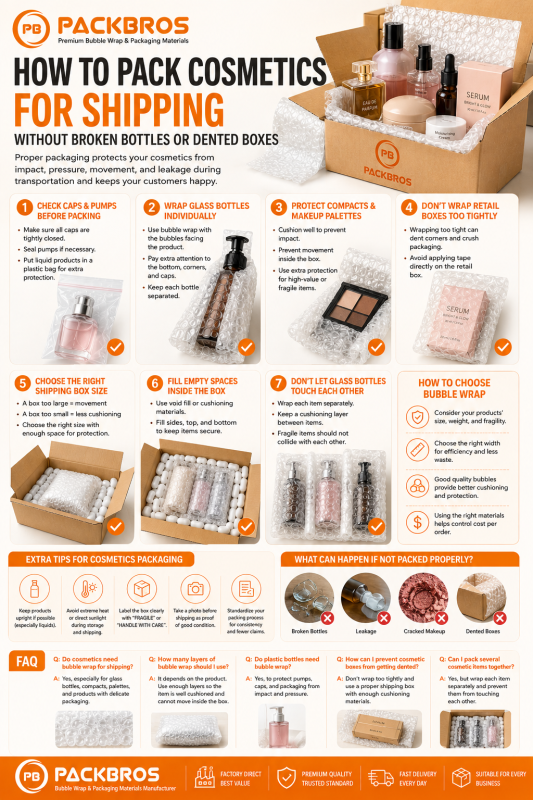
How to Pack Cosmetics for Shipping Without Broken Bottles or Dented Boxes
Shipping cosmetics requires more care than many ordinary products because a single order can contain glass bottles, plastic containers, pumps, compacts, palettes, and paper packaging—each with different risks during transportation.
A product may arrive without a broken bottle but still have a dented retail box. A bottle may survive the journey but leak because the cap or pump loosened in transit.
Effective cosmetic packaging therefore needs to protect against impact, pressure, movement, and leakage at the same time.
1. Check Caps and Pumps Before Packing
For serum, toner, foundation, perfume, and other liquid products, always check that every cap is tightly closed before wrapping.
Products with pumps or caps that could accidentally open during transportation may require additional sealing around the closure.
Placing liquid products inside a separate plastic bag can also provide an additional layer of protection in case leakage occurs.
Even excellent impact protection cannot prevent damage if a bottle opens inside the package.
2. Wrap Glass Bottles Individually
Perfume, serum, skincare, and other cosmetics packaged in glass bottles should generally be wrapped individually rather than bundled together.
Place the bubble side toward the product and wrap the bottle completely.
Pay particular attention to vulnerable areas such as:
- The bottom of the bottle
- Corners and edges
- Caps
- Pump mechanisms
- Protruding components
If several bottles are packed in the same shipping box, make sure they cannot directly collide with one another.
3. Protect Compacts and Makeup Palettes From Internal Impact
Pressed powder, blush, eyeshadow, and makeup palettes may not look as fragile as glass bottles, but the cosmetic product inside can crack or shatter when subjected to impact.
Wrap these items with sufficient cushioning and prevent them from moving freely inside the shipping box.
For particularly fragile or high-value products, the retail package can be wrapped first and then placed inside a protective shipping box with additional cushioning around it.
4. Don’t Wrap Retail Boxes Too Tightly
This is especially important for cosmetics sold in thin paperboard packaging.
Pulling bubble wrap or packing tape too tightly around a retail box can cause dented corners, crushed edges, or deformation before the parcel even leaves the warehouse.
Bubble wrap should fit securely without compressing the product packaging excessively.
Avoid applying packing tape directly onto the cosmetic retail box whenever possible.
For premium cosmetics, gift sets, and collectible packaging, the condition of the retail box is also part of the customer’s experience.
5. Choose the Right Shipping Box Size
A shipping box that is too large allows products to move and collide with the sides of the box.
A box that is too small can compress the cushioning material and reduce the space available to absorb impacts.
Choose a box that provides enough room for an appropriate amount of protective material around the products without leaving excessive empty space.
After packing, gently shake the box.
If you can feel the products moving, add more void-fill material.
6. Fill Empty Spaces Inside the Box
Even when every cosmetic product has been individually wrapped, the entire group of products can still move inside an oversized shipping box.
Use appropriate void-fill or cushioning material around the sides, top, and bottom to keep everything securely positioned.
The objective is not simply to make the box look full.
The goal is to prevent products from moving freely during transportation.
7. Don’t Let Glass Bottles Touch Each Other
Imagine a customer orders three bottles of serum.
Wrapping all three bottles together with one outer layer of bubble wrap may leave the bottles able to strike each other when the parcel is dropped.
A safer approach is to wrap each bottle separately and maintain a cushioning layer between individual products.
A simple rule is:
Fragile products should not be able to directly collide with other fragile products.
This is important because products can damage each other inside the package even when the outer shipping box remains intact.
How to Choose Bubble Wrap for Cosmetics
For online cosmetic stores shipping orders every day, bubble wrap should be selected according to the products being packed rather than price alone.
Consider the size and weight of your products, how fragile they are, and how efficiently the bubble wrap can be used for different package shapes.
Businesses with many product sizes can also choose different bubble-wrap widths according to their most common packaging requirements.
Using an appropriate roll width can reduce unnecessary cutting and waste while helping packing staff work more efficiently.
For businesses using large quantities of packaging materials, standardizing bubble-wrap sizes for different product categories can also help control packaging cost per order.
FAQ: Packing Cosmetics for Shipping
Do cosmetics need bubble wrap for shipping?
Protective cushioning is recommended for products that can be damaged by impact, including glass bottles, compacts, palettes, and cosmetics with delicate retail packaging.
How many layers of bubble wrap should I use for perfume?
There is no universal number. The required protection depends on the bottle’s weight, shape, glass thickness, value, and shipping conditions. The bottle should be sufficiently cushioned and unable to move freely inside the package.
Do plastic cosmetic bottles need bubble wrap?
Depending on the product, yes. Plastic bottles may not shatter like glass, but pumps, caps, containers, and retail packaging can still be damaged by pressure or impact.
How can I prevent cosmetic boxes from getting dented?
Avoid wrapping them too tightly and use an outer shipping box with enough room for protective cushioning.
Can several cosmetic products be packed together?
Yes. However, fragile products should be individually protected and arranged so they cannot directly collide with each other.
Conclusion
Packing cosmetics safely requires more than simply wrapping products in several layers of bubble wrap.
A good packing process should address the entire chain of potential damage:
Leakage → Broken Bottles → Cracked Makeup → Dented Retail Boxes → Movement Inside the Shipping Box
For online stores shipping cosmetics every day, creating a standardized packing process can help reduce damaged products, customer claims, and unnecessary packaging-material usage.
PackBros is a manufacturer of bubble wrap and packaging materials in Thailand, supplying protective packaging solutions for online sellers, wholesalers, factories, and organizations that regularly ship products.