

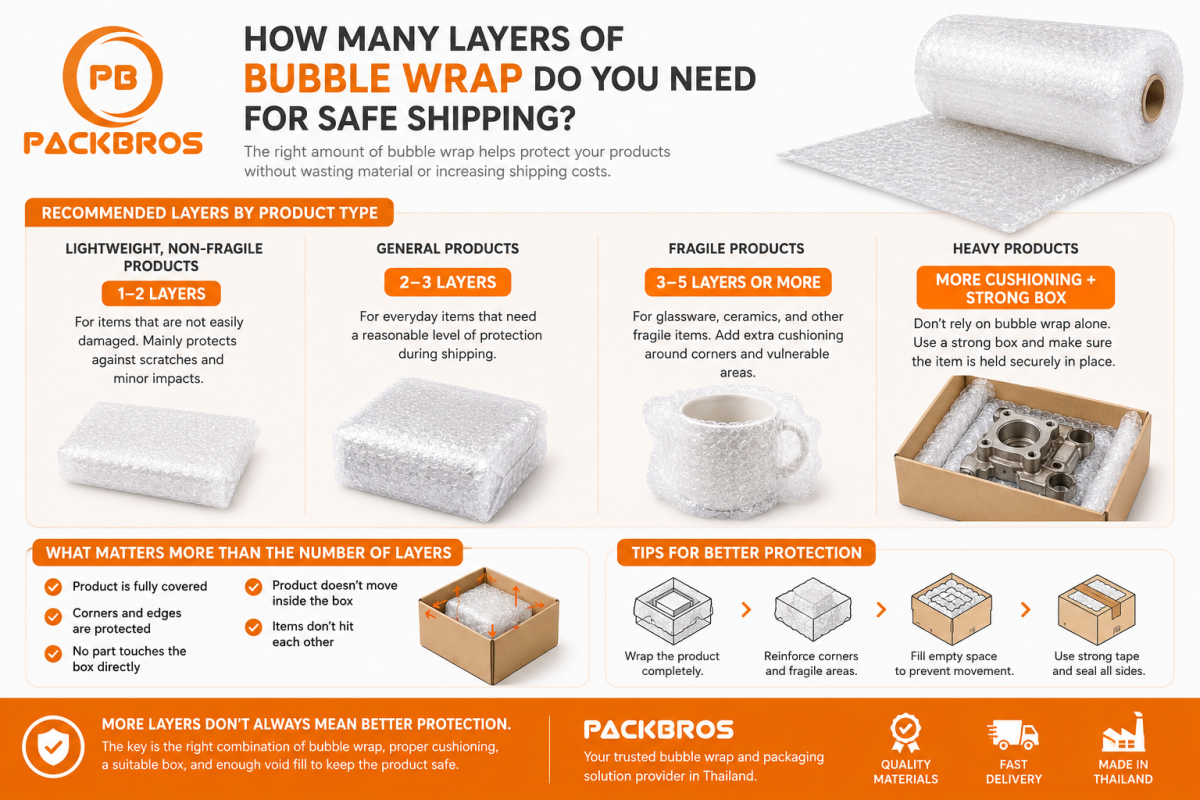
How Many Layers of Bubble Wrap Do You Need for Safe Shipping?
When packing products for shipping, one of the most common questions is: How many layers of bubble wrap should I use?
There isn’t one number that works for every product. A lightweight plastic item and a heavy piece of equipment obviously don’t need the same level of protection.
As a practical starting point, 1–2 layers may be enough for lightweight, non-fragile items, while 2–3 layers are more suitable for many everyday products. Fragile or heavy items usually need additional cushioning and extra protection around vulnerable areas.
The key is not simply adding more layers. It’s making sure the product is properly cushioned and cannot move around inside the box.
Is One Layer of Bubble Wrap Enough?
Sometimes.
For lightweight products that aren’t easily damaged, a single layer may provide enough protection against scratches, rubbing, and minor knocks.
However, if the product is being shipped by courier, it may be stacked, dropped, pushed, or moved several times before reaching the customer. In that situation, one layer may not provide enough cushioning.
Consider the product itself as well as the journey it will go through.
How Many Layers Should You Use?
Here’s a simple starting point.
Lightweight, Non-Fragile Products: 1–2 Layers
For lightweight items that aren’t likely to break, 1–2 layers of bubble wrap may be sufficient.
Examples include:
- Plastic products
- Small accessories
- Non-fragile household items
- Products that mainly need surface protection
Make sure the bubble wrap covers the entire item rather than leaving corners or edges exposed.
General Products: 2–3 Layers
For everyday products that need a reasonable level of protection during shipping, 2–3 layers are a good place to start.
Pay particular attention to corners and edges, as these areas often take the first impact if a parcel is dropped or knocked during handling.
Fragile Products: Add More Protection
Glassware, ceramics, decorative items, and other breakable products need more than a simple layer count.
You may need 3–5 layers or more, depending on the product, but the way you pack it is just as important.
Wrap fragile items individually and add extra cushioning around corners, handles, edges, and other vulnerable areas.
If several items are packed in the same box, don’t allow them to knock against each other.
Heavy Products: Don’t Rely on Bubble Wrap Alone
Heavy products create greater force when they move or fall, so simply adding more bubble wrap isn’t always enough.
Use sufficient cushioning around the product, but also choose a strong shipping box and make sure the item is held securely in place.
For heavier products, the complete packaging system matters more than the number of bubble wrap layers alone.
What Matters More Than the Number of Layers?
After wrapping the product, check a few things before closing the box:
- Is the entire product covered?
- Are the corners and edges properly protected?
- Can any part of the product touch the inside wall of the box directly?
- Does the product move when the box is gently shaken?
- If there are several items in the box, can they hit each other?
If the answer to any of these questions is yes, simply adding another full layer of bubble wrap may not be the best solution.
It may be better to reinforce a vulnerable area or add suitable void-fill material to stop the product from moving.
Can You Use Too Much Bubble Wrap?
Yes. More isn’t always better.
Using far more bubble wrap than necessary increases packaging costs, takes longer to pack, and may require a larger shipping box.
A larger parcel can also increase shipping costs, especially when carriers calculate charges based on dimensional weight.
The goal is to use enough bubble wrap to protect the product without wasting packaging material.
For businesses shipping hundreds or thousands of orders, even a small amount of unnecessary material per parcel can become a significant cost over time.
Remember: Bubbles Should Usually Face the Product
For most general packaging applications, place the bubble side toward the product and keep the flat side facing outward.
This puts the cushioning directly around the item while leaving a smoother outer surface for wrapping and taping.
For delicate, polished, painted, or easily marked surfaces, consider adding a protective layer such as paper or foam before wrapping the item with bubble wrap.
Why Can Products Still Break After Using Several Layers?
Because bubble wrap is only one part of protective packaging.
Imagine a fragile item wrapped in five layers of bubble wrap but placed inside a box with a large empty space around it. The product can still move from one side of the box to the other every time the parcel is handled.
That repeated movement can eventually cause damage.
A properly packed product should be cushioned and held securely inside the box.
After packing, gently shake the box. If you can clearly feel the product moving, add suitable void fill or adjust the packaging before shipping.
How Can Businesses Reduce Bubble Wrap Usage Without Increasing Damage?
For businesses shipping products every day, the best approach is to create a packing standard for each type of product.
Instead of allowing packers to decide how much bubble wrap to use for every order, test different packing methods and establish a standard that provides enough protection.
For example:
Product A → 2 layers + corner protection
Product B → 3 layers + void fill
Fragile Product C → individual wrapping + reinforced corners + void fill
This helps keep packaging consistent while reducing unnecessary material use.
It can also make packaging costs easier to calculate as order volume grows.
Frequently Asked Questions
Are two layers of bubble wrap enough?
For many lightweight or moderately fragile products, two layers can be a reasonable starting point. The final amount should depend on the product’s weight, shape, fragility, and shipping conditions.
How many layers of bubble wrap should I use for fragile items?
Fragile items usually require more cushioning than general products. Depending on the item, 3–5 layers or more may be appropriate, together with extra protection around vulnerable areas and proper void filling inside the box.
Does more bubble wrap always mean better protection?
No. Additional layers can provide more cushioning, but they won’t solve problems such as excessive movement inside the box, weak cartons, or poor protection around corners and edges.
Do heavy items need more bubble wrap?
Heavy products generally require stronger protection, but bubble wrap shouldn’t be the only consideration. A suitable box, adequate cushioning, and proper immobilization are also important.
Should I wrap the product first or put bubble wrap inside the box?
Wrap the product first. After placing it inside the shipping box, fill any remaining space as needed to prevent movement during transportation.
Final Answer: How Many Layers of Bubble Wrap Do You Need?
There is no universal number, but this is a useful starting point:
Lightweight, non-fragile products → 1–2 layers
General products → 2–3 layers
Fragile products → 3–5 layers or more, depending on the item
Heavy products → Additional cushioning plus a strong box and proper support
Most importantly, don’t judge packaging quality by thickness alone.
Good protective packaging combines the right amount of bubble wrap with proper corner protection, a suitable shipping box, and enough void fill to keep the product from moving during transit.
PackBros is a bubble wrap and protective packaging manufacturer in Thailand, supplying packaging materials for online sellers, wholesalers, factories, organizations, and businesses looking for reliable packaging solutions for domestic and export applications.