
Custom Clear Bubble Bags: Should the Opening Be on the Short or Long Side?
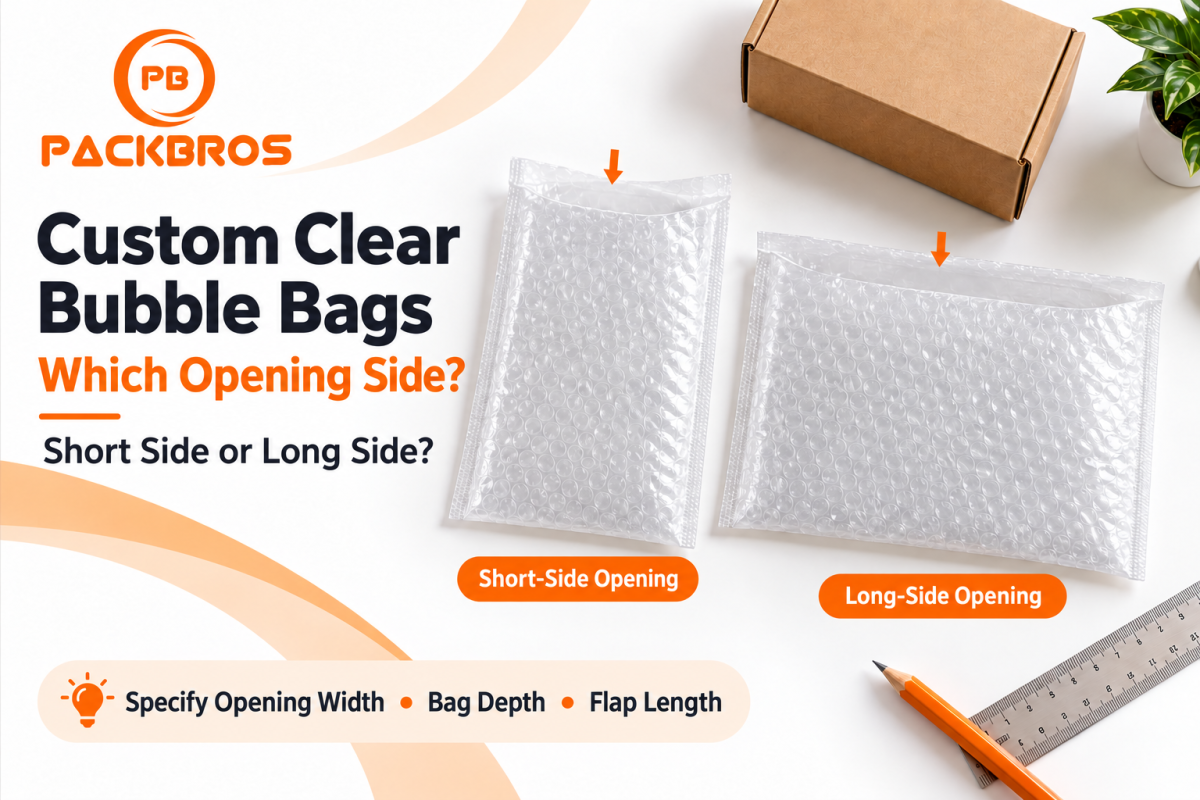
When ordering custom clear bubble bags, specify which edge should be open, along with the dimensions. Two bags with the same rectangular outline can work differently if they open on different sides.
Choose the opening based on how the product enters the bag, its shape, and your packing process. Then ask the manufacturer to confirm production feasibility before approving the specification and quotation.
Why “20 × 30 cm” May Not Be Enough
The buyer and manufacturer need to agree on which measurement describes the opening width and which describes the bag depth.
For a rectangular bag with sides measuring 20 and 30 cm, the opening could be arranged in two ways:
| Opening position | Opening width | Depth from opening to bottom |
|---|---|---|
| Short-side opening | 20 cm | 30 cm |
| Long-side opening | 30 cm | 20 cm |
These are illustrative dimensions. Although the rectangular outline is similar, the product enters through a different edge.
A clearer specification is:
“Opening width: 20 cm. Bag body depth: 30 cm.”
Also confirm whether these are external or usable internal dimensions. Any closing flap should be specified separately.
When Might a Short-Side Opening Work Well?
A short-side opening may suit products that slide comfortably into the bag lengthwise.
Check whether the complete product can pass through the opening without forcing, twisting, or catching on the edges. Include any inner wrapping, labels, accessories, or retail packaging used in the actual packing process.
Once inserted, the product should leave enough room for the intended closure.
Product thickness matters too. An item that appears narrower than the opening when viewed from the front may still be difficult to insert because of its depth or projecting parts.
Is a Long-Side Opening Always Easier?
A wider opening may make some products easier to insert, but it is not automatically the better option.
Changing the opening side also changes the depth available between the opening and the bottom of the bag.
Check that:
- The bag still covers the product as intended.
- Workers can hold and insert the product comfortably.
- The opening and flap can be closed properly.
- The packed item fits into its outer packaging.
A wide, flat product may be easier to insert through a long-side opening. However, this should be checked using the actual item rather than assumed from its measurements alone.
Specify the Adhesive Flap Relative to the Opening
The flap sits along the open edge. Changing that edge changes the closure layout as well.
For a bag with an adhesive flap, specify:
Opening width × Bag body depth + Flap length
For example:
Clear bubble bag with a 20 cm opening width, 30 cm body depth, and an additional 4 cm adhesive flap. Please confirm the measurement convention before production.
This example explains how to communicate dimensions. It is not a confirmed production specification or a recommended size for every product.
For bags without adhesive, explain what happens next: will the opening be folded, taped, or left open before the item goes into a carton? That information helps determine the space needed around the opening.
Include a Simple Drawing with Your Inquiry
A drawing can communicate the opening position more clearly than dimensions alone.
Show:
- The open edge, marked with an arrow.
- Opening width.
- Bag body depth.
- Flap length, if required.
- The direction in which the product will be inserted.
Ask the manufacturer to confirm the same drawing or specification before it becomes the reference for sampling and pricing.
If dimensions change later, update the drawing so everyone works from the same version.
Evaluate the Complete Packing Process
When a suitable sample is available, ask the people who pack the products to test the full sequence:
Pick up the bag → Insert the product → Close the opening → Place into outer packaging
Record where workers need to rotate the product, reposition the bag, or adjust the closure.
If comparing two opening arrangements, use the same product and working conditions. Compare total packing time and handling problems, rather than measuring insertion speed alone.
For more guidance, read How Can Clear Bubble Bags Save Packing Time and Packaging Costs?.
Choosing an opening position does not establish that the complete package provides sufficient shipping protection. Fragile, heavy, sharp-edged, or sensitive products need an application-specific assessment of the materials and outer packaging.
Planning Custom Clear Bubble Bags with PackBros
To discuss a custom clear bubble bag with PackBros, prepare:
- Actual product dimensions and photographs.
- Required quantity for each size.
- Adhesive or non-adhesive requirements.
- A drawing showing the preferred opening.
- Required delivery timing.
Opening arrangements, available dimensions, minimum quantities, prices, and production schedules must be confirmed for each project.
PackBros is preparing for a planned production launch in November 2026. Production availability remains subject to confirmation following machine installation and production trials.
For preliminary inquiries, contact LINE: @packbros or call 098-851-3358 for English assistance.
Frequently Asked Questions
Are 20 × 30 cm and 30 × 20 cm bags the same?
Not necessarily. If the first measurement identifies the opening width, the two specifications describe different opening arrangements. Confirm the measurement convention with the manufacturer.
If the product will not pass through the opening, should I change the opening side?
First check usable internal dimensions, product thickness, and insertion direction. Changing the opening side is one option, but the resulting depth and closure must also work.
Do non-adhesive bags still need an opening-side specification?
Yes. The opening affects product insertion, handling, and the next packing step, even without an adhesive flap.
Can I change the opening side after receiving a quotation?
Request a revised assessment before confirming the order. The change may affect production requirements, flap construction, pricing, and delivery timing.
Before ordering custom clear bubble bags, confirm the opening width, body depth, and open edge. A simple drawing helps turn those measurements into a specification both buyer and manufacturer understand.