
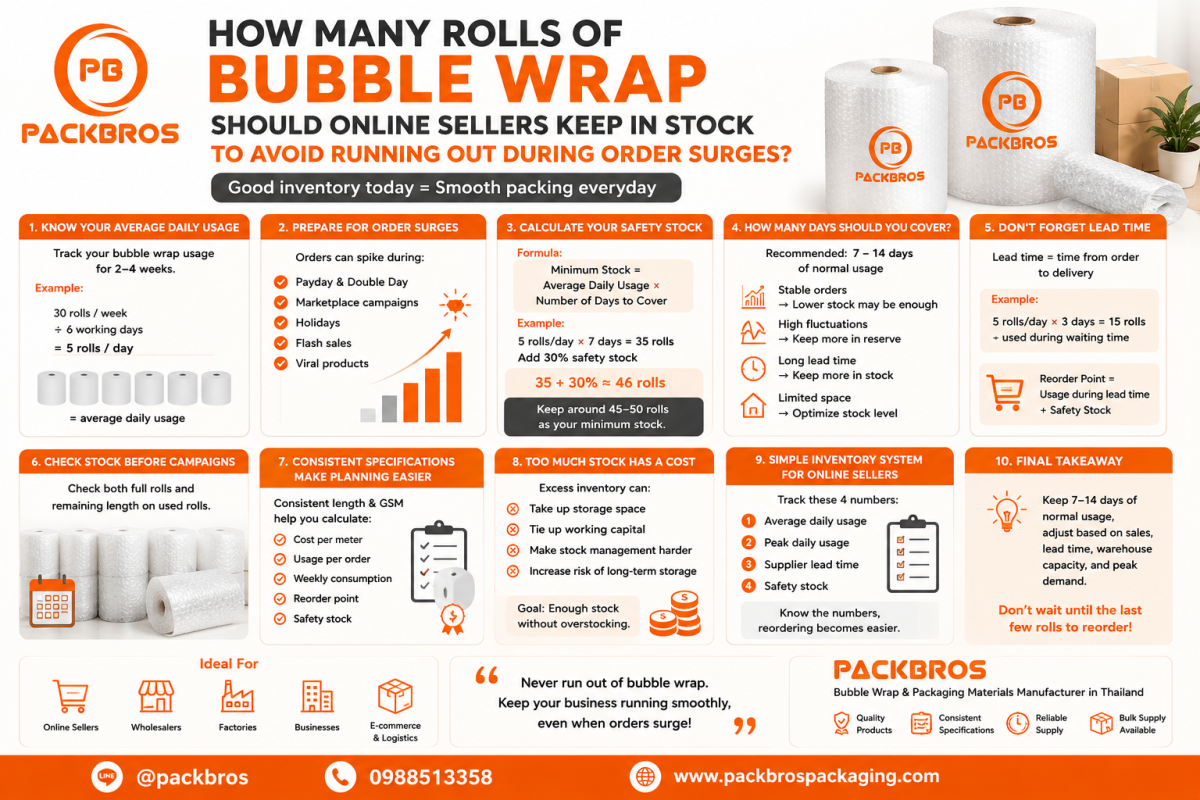
How Many Rolls of Bubble Wrap Should Online Sellers Keep in Stock to Avoid Running Out During Order Surges?
Running out of bubble wrap may seem like a small problem, but for an online business handling dozens or hundreds of orders per day, it can quickly disrupt the entire packing operation.
When packaging materials run out unexpectedly, businesses may face packing delays, late shipments, emergency purchases at higher prices, and unnecessary pressure on warehouse staff.
So, how much bubble wrap should an online seller keep in reserve?
Instead of guessing the number of rolls, businesses can calculate their requirements based on average daily usage, supplier lead time, and safety stock.
1. Start With Your Average Daily Bubble Wrap Usage
The first step is to understand how much bubble wrap your business actually uses.
Track your consumption for approximately 2–4 weeks.
For example, suppose an online store uses:
30 rolls per week
and operates its packing department 6 days per week.
Average daily usage would be:
30 ÷ 6 = 5 rolls per day
This gives you a useful starting point, but average consumption alone is not enough.
Online orders rarely remain exactly the same every day.
2. Prepare for Sudden Order Surges
Order volumes can increase significantly during:
- Payday campaigns
- Double Day promotions
- Marketplace campaigns
- Holiday seasons
- Flash promotions
- Viral product periods
If your normal consumption is 5 rolls per day but increases to 8–10 rolls during a major campaign, keeping inventory based only on average usage could leave your packing team without enough material.
This is where Safety Stock becomes important.
3. A Simple Formula for Bubble Wrap Safety Stock
A basic starting formula is:
Minimum Stock = Average Daily Usage × Number of Days You Want to Cover
For example:
Average usage = 5 rolls/day
Desired stock coverage = 7 days
Therefore:
5 × 7 = 35 rolls
You can then add additional Safety Stock based on fluctuations in sales and supplier lead time.
If you add 30%:
35 + 30% = approximately 46 rolls
In this example, the business could consider maintaining approximately 45–50 rolls as its minimum inventory level.
Once stock approaches this level, it may be time to reorder rather than waiting until only a few rolls remain.
4. How Many Days of Bubble Wrap Should You Keep?
There is no universal number that works for every business.
However, keeping approximately 7–14 days of normal usage can be a useful starting point for many businesses.
The appropriate level depends on several factors:
Stable order volume: A smaller safety stock may be sufficient.
Highly variable order volume: More reserve inventory may be necessary.
Long supplier lead time: More stock should generally be kept on hand.
Limited warehouse space: Inventory levels may need to be optimized more carefully.
The objective is not to keep as much stock as possible. It is to maintain enough stock to continue packing even when something unexpected happens.
5. Don’t Forget Supplier Lead Time
Supplier lead time is one of the most important factors when determining when to reorder.
Suppose your business uses:
5 rolls per day
and your replacement stock takes:
3 days to arrive
You will consume approximately:
5 × 3 = 15 rolls
while waiting for the new shipment.
If you wait until only 15 rolls remain before ordering, there is almost no margin for unexpected demand or shipping delays.
A better reorder point would therefore include additional Safety Stock.
For example:
Reorder Point = Expected Usage During Lead Time + Safety Stock
This provides a buffer if orders suddenly increase or the shipment arrives later than expected.
6. Check Inventory Before Payday and Major Campaigns
Online sellers using marketplaces such as Shopee, Lazada, or TikTok Shop should review packaging inventory before major campaign periods.
Do not check only the number of rolls in the warehouse.
Also check how much material actually remains on opened rolls.
Five partially used rolls may contain significantly less bubble wrap than five unopened full rolls.
This distinction becomes particularly important when preparing for high-volume packing days.
7. Consistent Roll Specifications Make Inventory Planning Easier
There is another factor that businesses sometimes overlook: actual roll length and specification consistency.
Suppose your packing department calculates consumption based on a 100-meter roll.
If the actual length varies significantly from one batch to another, the number of rolls consumed per week will also become less predictable.
For businesses using bubble wrap continuously, consistent specifications make it easier to calculate:
cost per meter, consumption per order, weekly usage, reorder points, and required safety stock.
Therefore, businesses purchasing bubble wrap in volume should consider roll length, weight, GSM, and specification consistency, rather than comparing only the price per roll.
8. Too Much Safety Stock Can Also Cost Money
Running out of bubble wrap is a problem, but holding excessive inventory also has a cost.
Too much packaging inventory can:
occupy valuable warehouse space,
tie up working capital,
make stock management more difficult,
and increase the risk of materials being stored for unnecessarily long periods.
The goal is therefore not:
“Keep as much bubble wrap as possible.”
It is:
“Keep enough bubble wrap to protect the operation without holding unnecessary inventory.”
9. A Simple Inventory System for Small and Medium Online Sellers
You do not necessarily need complicated warehouse software to start managing bubble wrap inventory.
Track these four numbers:
Average daily usage
How many rolls are normally consumed per day?
Peak daily usage
How many rolls are consumed during high-volume periods?
Supplier lead time
How many days does replenishment normally take?
Safety Stock
How much additional inventory do you want available for unexpected demand?
Once these numbers are known, purchasing decisions become much easier.
Instead of noticing that “the bubble wrap looks like it is almost gone,” your team has a defined point at which a new order should be placed.
So, How Many Rolls of Bubble Wrap Should You Keep in Reserve?
There is no single correct number for every online seller.
A business using 2 rolls per day has very different requirements from a warehouse using 30 rolls per day.
A practical starting point is to maintain approximately 7–14 days of normal consumption, then adjust the amount based on:
- Sales volatility
- Campaign schedules
- Supplier lead time
- Warehouse capacity
- Historical peak demand
Most importantly, do not wait until the final few rolls before placing the next order.
Good packaging inventory management helps ensure that when orders suddenly increase, your packing operation can continue without interruption.
PackBros is a bubble wrap and packaging materials manufacturer in Thailand, supplying online sellers, wholesalers, factories, organizations, and businesses that require packaging materials for continuous operations.
Frequently Asked Questions (FAQ)
How many days of bubble wrap should an online seller keep in stock?
Approximately 7–14 days of normal usage can be used as a starting point, then adjusted according to supplier lead time and fluctuations in order volume.
Should I increase bubble wrap inventory before major sales campaigns?
Yes, especially if historical data shows higher order volumes during Payday, Double Day, holiday periods, or marketplace campaigns.
When should I reorder bubble wrap?
Calculate how much bubble wrap will be consumed while waiting for the next delivery and add an appropriate amount of Safety Stock.
Is it better to buy as much bubble wrap as possible at once?
Not necessarily. Excess inventory uses warehouse space and working capital. The objective is to maintain sufficient stock without unnecessary overstocking.
What should businesses with highly unpredictable order volumes do?
Use historical peak consumption in addition to average daily usage and consider maintaining a higher Safety Stock level.
SEO Title
How Much Bubble Wrap Should Online Sellers Keep in Stock?
Meta Description
Learn how to calculate bubble wrap inventory using daily consumption, supplier lead time and safety stock to prevent shortages during order surges.
Slug
bubble-wrap-safety-stock-for-online-sellers