

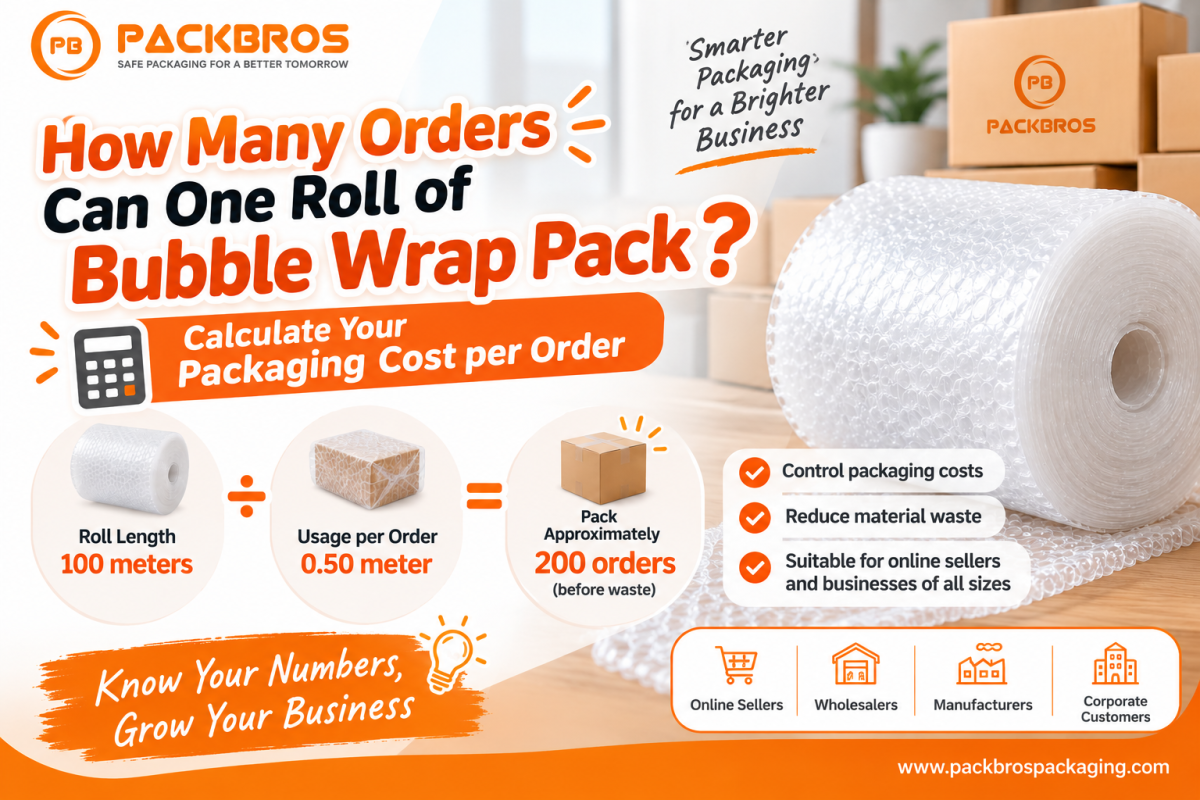
How Many Orders Can One Roll of Bubble Wrap Pack? Calculate Your Packaging Cost per Order
When purchasing bubble wrap, many businesses compare products based mainly on the price per roll.
However, for online sellers, warehouses, manufacturers, and businesses that pack products every day, there is another number that can be much more useful:
How many orders can one roll of bubble wrap actually pack?
A cheaper roll does not always mean a lower packaging cost.
By knowing how much bubble wrap is used for each order, businesses can calculate packaging costs more accurately, plan inventory, and compare different bubble wrap options more effectively.
How to Calculate How Many Orders One Roll Can Pack
The basic formula is:
Number of orders = Total roll length ÷ Bubble wrap used per order
For example:
If one roll contains 100 meters of bubble wrap, and each order uses approximately 0.50 meter:
100 ÷ 0.50 = approximately 200 orders
In actual packing operations, however, businesses should also allow for cutting waste, overlapping layers, and differences in product sizes.
Calculate Bubble Wrap Cost per Order
Suppose a 100-meter roll of bubble wrap costs THB 200.
First, calculate the cost per meter:
THB 200 ÷ 100 meters = THB 2 per meter
If each order requires approximately 0.50 meter:
THB 2 × 0.50 = THB 1 per order
For a business shipping 3,000 orders per month, the estimated bubble wrap cost would therefore be:
THB 3,000 per month
When order volumes increase, even a small difference in packaging cost per order can add up to hundreds or thousands of baht over time.
Do Not Calculate Based on Length Alone
Roll length is not the only factor that affects packaging costs.
The amount of bubble wrap required to adequately protect a product is equally important.
Very thin bubble wrap may have a lower purchase price, but if additional layers are required to provide sufficient protection, the amount of material used per order may increase.
On the other hand, using more material than necessary does not automatically provide better value.
Businesses should consider the appropriate bubble wrap thickness, product weight, fragility, shape, and shipping conditions together when determining the right amount of protective packaging.
Bubble Wrap Width Also Affects Cost per Order
Choosing the right roll width can make a significant difference in material usage.
For example, if a product only requires approximately 30 cm of bubble wrap width but the packing team regularly uses a 65 cm wide roll, excess material may need to be folded or cut away.
The waste may appear insignificant for one package.
But across hundreds or thousands of orders, the additional material can become a measurable packaging expense.
The most economical roll is therefore not necessarily the widest or cheapest roll. It is the size that fits the products being packed with minimal unnecessary material.
A Cheaper Roll Does Not Always Mean Cheaper Packaging
When comparing bubble wrap from different suppliers, businesses should consider at least three factors:
- Price per roll
- Actual roll length and amount of material
- Amount of bubble wrap required per order
For example, one roll may have a lower purchase price but contain less material or require additional layers when wrapping products.
In that situation, its actual cost per packed order may be higher.
This is why businesses that use large quantities of packaging materials should evaluate the cost per meter and cost per order instead of comparing only the selling price of each roll.
Heavy and Fragile Products Require a Different Approach
Reducing packaging cost should never mean reducing protection below an appropriate level.
Heavy products, products with sharp corners, and fragile items may require additional cushioning around vulnerable areas or other protective materials in combination with bubble wrap.
The objective is therefore not simply to achieve the lowest possible bubble wrap cost per order.
The better goal is to use an appropriate amount of packaging material while maintaining reliable protection during transportation.
What Should Online Sellers Measure?
Businesses that want better control over packaging costs can start by measuring actual material usage for their most frequently shipped products.
Record:
- Bubble wrap length used per product
- Number of layers required
- Appropriate roll width
- Number of orders actually packed from one roll
- Material waste during packing
Once these numbers are available, purchasing decisions become much easier.
Instead of asking:
“How much does this roll cost?”
Businesses can ask:
“How much does this bubble wrap actually cost us per order?”
That is a much more useful number for managing packaging expenses at scale.
Choose Bubble Wrap Based on Actual Usage
PackBros manufactures and supplies bubble wrap, bubble mailers, and protective packaging solutions in Thailand for online sellers, wholesalers, manufacturers, warehouses, and corporate customers. The English PackBros product page already presents bubble wrap as a solution for businesses that ship products regularly.
Choosing the appropriate bubble wrap width and measuring actual usage per order can help businesses reduce unnecessary material consumption and manage packaging costs more effectively.
Frequently Asked Questions
How many orders can a 100-meter roll of bubble wrap pack?
It depends on product size, the number of layers required, and the amount of bubble wrap used for each item. If approximately 0.50 meter is used per order, a 100-meter roll could theoretically pack around 200 orders before allowing for cutting waste and other losses.
Should businesses calculate bubble wrap cost per roll or per order?
For businesses that ship products regularly, cost per order is often more useful because it shows how packaging material affects the actual cost of fulfilling each order.
Is wider bubble wrap always more cost-effective?
No. A roll that is significantly wider than the product may create unnecessary material usage or cutting waste. The appropriate width depends on the dimensions and packing method of the product.
Does buying the cheapest bubble wrap always reduce packaging costs?
Not necessarily. Businesses should compare price, actual roll length, material quantity, and the amount required to protect each product.